
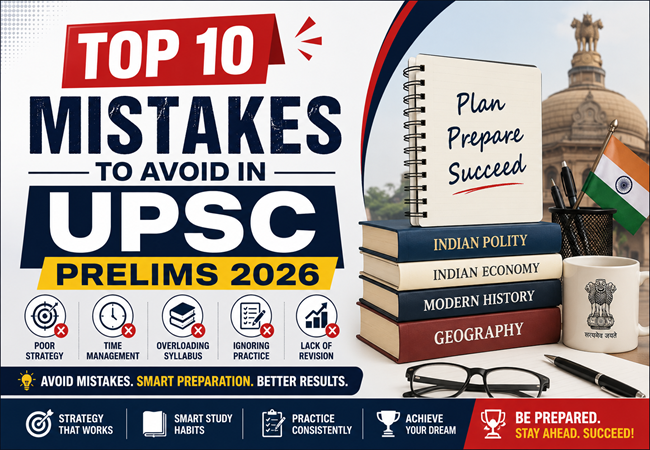
The UPSC Prelims exam 2026 is approaching and aspirants are working hard day and night to ensure that they crack the exam. However, despite all the hard work some mistakes could totally ruin everything. Many aspirants experience failure due to avoidable mistakes and lack of clarity. The most commonly repeated mistake is ignoring the UPSC syllabus and previous year question papers which creates confusion regarding relevant and irrelevant topics. Another common mistake is relying on too many study resources which creates information overload and exhaustion.
Top 10 Mistakes to Avoid in UPSC Prelims 2026. To clear the UPSC Prelims 2026, avoid mistakes like ignoring the syllabus/PYQs, skipping revision, and neglecting the CSAT paper. For UPSC Prelims 2026, the competition is expected to be even tougher. Therefore aspirants must ensure that they don’t neglect current affairs, underestimate CSAT, ignore revision, avoid mock tests, apply poor time management skills, compare oneself to others, apply guesswork without an appropriate strategy and ignore health for the sake of studying long hours. Aspirants should understand that one small mistake can prove to be fatal and they need to be extra cautious while preparing and giving the Prelims exam. Choosing the IAS coaching in Delhi can help avoid common UPSC Prelims mistakes through expert mentorship, regular mock tests, updated study material, and strategic preparation guidance for better success.
What is the UPSC Prelims Exam?
The UPSC Prelims Exam is the first stage of the Civil Services Examination. It is conducted to shortlist aspirants for the UPSC Mains Exam. It comprises two objective type papers such as GS Paper I and CSAT paper which are held on the same day in offline mode. It tests aspirants on general awareness, analytical ability, comprehension and aptitude skills.
Top 10 Common Mistakes to Avoid in UPSC Prelims 2026
For success in the Prelims exam, aspirants should not ignore the UPSC syllabus, rely on too many study sources, neglect current affairs, underestimate CSAT, avoid mock tests and ignore health. Here are the top 10 mistakes to avoid in UPSC Prelims 2026 and suggestions on how aspirants can improve their performance:-
1. Ignoring the UPSC Syllabus and Previous Year Questions
Many aspirants start preparation without properly understanding the UPSC syllabus. The syllabus acts as the roadmap for preparation which helps to understand the difference between relevant and irrelevant topics. Also, previous year questions help identify important topics and question patterns. Therefore, aspirants should carefully analyze and solve at least 10 years of upsc prelims pyqs.
2. Relying on Too Many Study Sources
Aspirants should avoid referring to multiple books, PDFs, coaching notes and online resources. This creates confusion and information overload. It is wise to stick to limited and reliable sources for each subject. Aspirants should revise the same material multiple times instead of constantly changing study materials.
3. Neglecting Current Affairs
Current affairs play a very important role in UPSC Prelims. Many aspirants either ignore them completely or study them without proper resources. They should develop the habit of reading newspapers regularly and connecting current affairs with static subjects such as Polity, Economy, Environment and Geography.
4. Underestimating CSAT
Since CSAT is qualifying in nature, many aspirants underestimate thinking it’s too easy. Avoid ignoring CSAT preparation until the last moment. Dedicate daily time to comprehension, logical reasoning, and basic numeracy practice. To prepare UPSC CSAT in 90 days, solve previous years papers and take mock tests regularly to improve speed, accuracy, and confidence for clearing the qualifying CSAT paper in UPSC Prelims 2026. However, several serious aspirants fail every year because they don’t score well in CSAT. Therefore, aspirants should practice reading comprehension, logical reasoning and basic numeracy regularly. They should also give mock tests to improve speed and accuracy.
5. Lack of Revision
Reading new topics every day without revising old ones leads to poor retention of information. It is recommended that aspirants allocate dedicated time for revision every week. Multiple revisions are important to retain facts, concepts and current affairs effectively.
6. Avoiding Mock Tests
Some aspirants delay mock tests until the final months before the exam. This reduces exam temperament and weakens time management skills. Instead, they should start practicing through mock tests as early as possible. Regular mock tests help improve question solving ability, eliminate silly mistakes and build confidence under exam pressure.
7. Poor Time Management During Preparation
Without a proper study plan, aspirants often spend too much time on favorite subjects while ignoring weaker areas. Therefore, they should create a realistic timetable with balanced time allocation for static subjects, current affairs, revision and test practice to ensure appropriate time management during preparation.
8. Guesswork Without Strategy
UPSC Prelims has 1/3rd negative marking and random guessing can significantly reduce scores. Many aspirants attempt excessive questions without elimination techniques whereas, they should learn smart guessing methods, logical elimination strategies and risk management during mock test practice.
9. Ignoring Health and Mental Balance
Continuous preparation without rest leads to burnout, stress and reduced productivity. Ignoring health and mental balance for the sake of preparation can be very risky as it reduces the overall productivity. Aspirants should maintain a healthy routine with proper sleep, exercise and short breaks to improve concentration and consistency.
10. Comparing Yourself with Others
Every aspirant has a different preparation style, learning speed and background. Constant comparison with others creates unnecessary pressure and self doubt. Instead, aspirants should focus on their own progress, consistency and improvement rather than comparing study hours or test scores with others.
UPSC Exam Pattern 2026 for Prelims, Mains & Interview
The UPSC Exam Pattern consists of three stages: Prelims, Mains, and Interview. UPSC Exam includes a screening Preliminary Exam which is objective in nature, a descriptive Mains Exam which is written and a Personality Test. Total marks for the final merit list are 2025, out of which 1750 marks are dedicated for Mains and 275 for the Interview. Let’s take a look at the UPSC exam pattern 2026 for Prelims, Mains and Interview.
UPSC Exam Pattern 2026 for Prelims
The UPSC Prelims consists of two papers such as General Studies Paper and Civil Services Aptitude Test. The GS paper evaluates an aspirant’s grasp of diverse subjects such as History, Geography, Polity. While the CSAT evaluates logical reasoning and analytical skills of the aspirant. The UPSC Prelims Exam 2026 serves as a filtering mechanism which allows a limited number of aspirants to progress to the Mains Examination.
UPSC Exam Pattern 2026 for Mains
The UPSC Mains Exam pattern 2026 is the core evaluation phase. It has a mix of compulsory and optional papers and includes language papers, essay writing, general studies papers and optional subject papers. The UPSC Mains exam delves deep into an aspirant’s understanding of subjects, their ability to articulate ideas and their analytical thinking skills. It is a written examination consisting of 9 papers out of which 2 papers are qualifying in nature. The marks obtained in the remaining 7 papers and the interview test are considered for making the final merit list.
UPSC Exam Pattern 2026 for Personality Test
The final stage of the UPSC Civil Service Exam is the Interview or UPSC Personality Test. A panel of UPSC members evaluates qualities such as mental alertness, logical thinking, balance of judgement, social skills, leadership and moral integrity. This stage aims to determine the aspirant’s suitability for the dynamic and diverse responsibilities of civil services. The interview process typically follows a structured pattern:
- Duration: The interview usually lasts for about 30-40 minutes.
- Panel: The interview is conducted by a panel of experts which includes experienced bureaucrats, academicians and subject matter specialists.
- Marks in Interview: UPSC Interview 2026 consists of a total of 275 marks which is included in the final merit list along with UPSC Mains 2026 marks.
Conclusion
Success in UPSC Prelims 2026 depends not only on hardwork but by avoiding mistakes such as poor time management during preparation, guesswork without strategy, comparing oneself to others, relying on too many study resources, neglecting current affairs and ignoring the UPSC syllabus. The UPSC prelims consists of two papers such as General Studies and CSAT paper. An Top IAS Coaching in Delhi provides expert guidance, structured study material, mock tests, and experienced faculty to help aspirants prepare effectively for UPSC Civil Services Examination and achieve their IAS dream. The CSAT paper is qualifying in nature and the marks are not included in the final merit list. The Prelims exam works as a screening test to evaluate aspirants for the Mains exam.
