
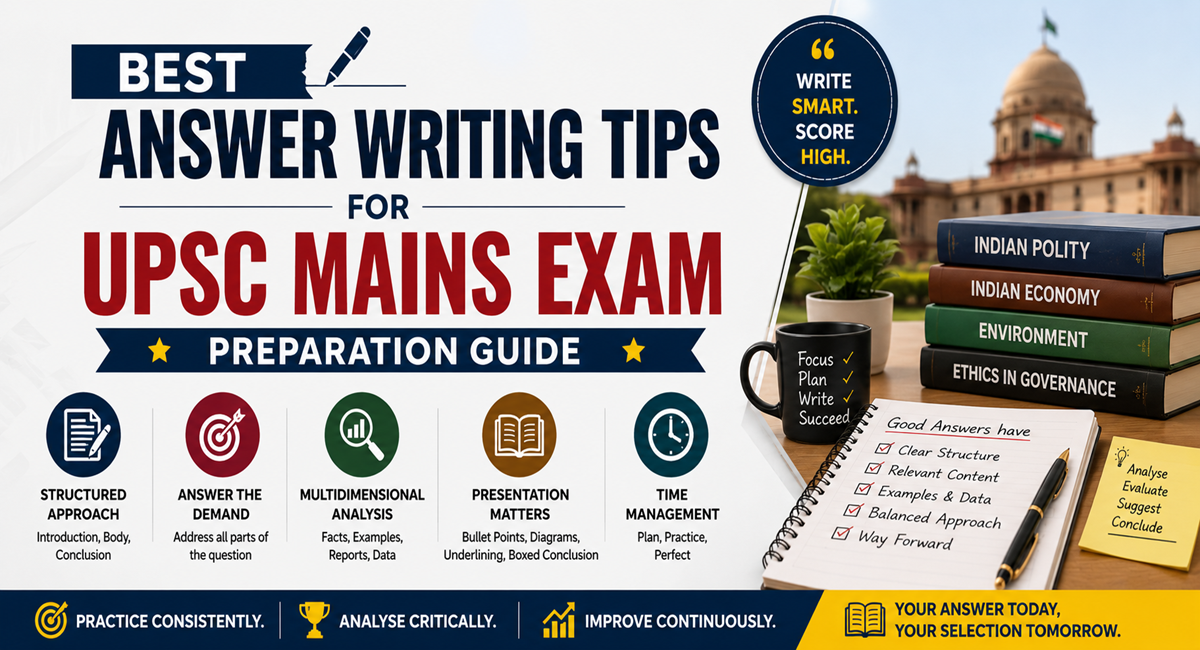
Mastering answer writing for the UPSC Mains is about structure, time management, and clarity. To start your UPSC preparation, explore the UPSC toppers strategies and UPSC syllabus with upsc previous year questions papers on the Vajirao & Reddy Institutes IAS Previous Year Questions Portal. To score high in the UPSC Civil Services Mains Examination, candidates must answer with clarity and precision by directly addressing the core demand of the question through a well-structured Introduction-Body-Conclusion (IBC) approach, while maintaining a balance between speed, analytical depth, relevant content, and multi-dimensional perspectives. The UPSC Mains examination is approaching. Aspirants are going through mixed emotions of excitement, fear and worry about their readiness to face the examination with confidence. However, there’s one way aspirants can enhance their scoring potential and gain some surety about the unpredictable UPSC Mains exam. Answer writing is one such skill which can strongly improve scores and push through the difficulties of the examination. Quality answer writing matters because it translates knowledge into marks, enhances time management and brings out multidimensional analysis.
The core elements of a high scoring answer are Introduction, Main Body and Conclusion. Without this structure in place, answers don’t look impressive and tidy. To write high quality answers, aspirants should enhance visual presentation, quote authentic sources of the facts used in the answers such as NITI Aayog or PIB reports, use examples to make the answers scoring, deconstruct the question directive and write multidimensional answers.
What is the UPSC Mains Examination?
The UPSC Mains Examination is the second stage of the UPSC Civil Services Examination. It is a descriptive written exam designed to evaluate an aspirant’s intellectual depth, mental clarity, analytical skills and comprehensive understanding of various subjects along with administrative aptitude. The UPSC Mains examination consists of 9 papers which includes language papers, general studies papers, optional subject papers and an essay paper. Clearing the objective Prelims Examination qualifies a candidate for the UPSC Mains Exam. However, the final selection for reputable services such as the IAS, IPS, and IFS largely depends on the marks secured in the Mains Examination, along with performance in the next Personality Test (Interview).
Why Quality Answer Writing Matters in the UPSC Exam?
In the UPSC Civil Services Examination, effective upsc mains answer writing is the key factor that converts knowledge into high scores and ultimately secures a top rank. Since the UPSC Mains Examination carries 1750 out of the total 2025 marks, the quality, clarity, and presentation of your written answers play a decisive role in final selection. Quality answers matter in the UPSC exam because it translates knowledge into marks, it meets exam expectations, enhances time management and multidimensional analysis. Let’s understand exactly why quality answer writing holds the key to success in the UPSC exam:-
1. Translates Knowledge into Marks
Understanding a concept and presenting it effectively to score marks are two entirely different skills in the UPSC Mains Examination. Examiners are not concerned with how much you have studied; they assess how clearly and concisely you can express your knowledge within the prescribed 150 or 250 word limits. Well-structured, high-quality answer writing can make even average content appear comprehensive and impactful, significantly enhancing your scoring potential by 15%-25%. Quality answers translate knowledge into marks. Knowing a topic and presenting it to score marks are important skills. A structured answer shortens large amounts of information into crisp, relevant and high scoring responses.
2. Meets Exam Expectations
Quality answer writing is the most decisive factor in the UPSC Mains Exam. Since examiners assess candidates entirely through their written responses, effective answer presentation plays a crucial role in transforming knowledge into high-scoring performance. The examiner grades hundreds of copies. Answers that are clean, precise and easy to read using headings, bullet points and sub-points demonstrate clarity of thought and competence. These answers definitely get good scores because they meet exam expectations. The UPSC Mains syllabus covers Essay, General Studies papers, and Optional subjects. It demands analytical depth, conceptual clarity, current affairs integration, and multidimensional understanding of governance, society, economy, and ethics.
3. Enhances Time Management
The UPSC Mains Examination is a rigorous test of both speed and mental endurance, requiring candidates to answer 20-25 questions in intensive 3-hour sessions. Without regular answer writing practice, aspirants often spend excessive time on initial questions and struggle to complete the paper. Consistent practice helps develop the ability to think quickly, organize ideas logically, structure answers effectively, and complete the examination within the prescribed time limit. Practicing answer writing within strict limits trains the mind to recall, process and write under pressure without missing out on covering all questions. This enhances time management skills in aspirants which is very important for the UPSC Mains exam.
4. Tests Multidimensional Analysis
Multidimensional analysis in UPSC answer writing transforms responses from merely informative to administratively mature. It reflects a candidate’s ability to examine an issue through multiple interconnected dimensions such as economic, political, social, ethical, environmental, and governance perspectives. This holistic approach demonstrates the critical thinking, balanced judgment, and analytical depth expected from a future civil servant. UPSC questions are analytical. Quality writing ensures that aspirants cover various dimensions such as social, economic, political and ethical while sticking precisely to question directives like critically analyze or evaluate.
Core Elements of a High Scoring Answer in UPSC Mains
A high-scoring UPSC Mains answer effectively addresses the demand of the question directive with precision, incorporates multidimensional perspectives supported by relevant current affairs and data, maintains a clear and logical structure through the use of subheadings and bullet points, and concludes with a balanced, solution-oriented approach. The core elements of a high scoring answer in the UPSC Mains are Introduction, Main Body and Conclusion. Let’s take a look at the core elements of scoring answers in the UPSC Mains:-
1. Introduction
The Introduction is the first part of the answer. It briefly defines the core theme and provides relevant context such as a recent data point, committee recommendation and constitutional article to set the stage. A high scoring UPSC Mains answer begins with a crisp, contextual introduction of 2–3 lines that clearly reflects an understanding of the core demand of the question. Effective introductions may include precise definitions, relevant constitutional provisions, recent data, or a strong contemporary hook. Generic or vague opening statements should be strictly avoided.
2. Main Body
The Main Body is the most important part of the answers which address all parts of the directive. Aspirants should use bullet points, bold key terms and integrate real-world examples, diagrams and flowcharts wherever applicable to add value and save space. The main body forms the core of a UPSC Mains answer and carries the highest weightage. To score well, it should be structured for easy readability, logically coherent, and multi-dimensional in coverage. Effective presentation involves the strategic use of subheadings, bullet points, relevant current affairs, and precise facts to directly address every part of the question.
3. Conclusion
The conclusion is the ending part of the answers. The end should be balanced and optimistic. It must offer a forward looking perspective and aspirants should summarize the core argument and suggest a possible administrative solution. A high-scoring UPSC Mains answer is built on the I-B-C framework (Introduction, Body, Conclusion), combined with analytical depth and meaningful value addition. Strong answers go beyond mere information delivery; they directly respond to the question’s directive while demonstrating a structured, solution-oriented mindset expected of a future civil servant. Selecting the best optional subject for UPSC Mains requires alignment with interest, background, scoring potential, and availability of resources. Strong conceptual understanding and consistent practice are key to maximizing performance.
Best Answer Writing Tips for UPSC Mains Exam h2
To score high in the UPSC Mains exam, the answers should have examples, enhanced visual presentation, authentic sources of facts and multidimensional perspective. Clearing the Civil Services Examination requires a disciplined command over the Introduction-Body-Conclusion (I-B-C) framework, effective time management, and consistent multidimensional content delivery. The core objective in UPSC Mains is not to craft one perfect answer, but to produce reliably strong, above-average responses across all 20 questions. Let’s take a look at best answer writing tips used by toppers to maximize their scores:-
1. Enhance Visual Presentation
Enhancing visual presentation in the UPSC Mains exam can help secure those crucial marginal marks that influence final ranking. To create maximum impact at a glance, avoid dense paragraphs and instead use structured bullet points, well-organized flowcharts, simple block diagrams, and rough maps wherever relevant. Additionally, underline key terms to highlight core ideas and enclose the concluding statement within a box for better emphasis and clarity. UPSC aspirants should avoid writing dense paragraphs. Instead, they should write in crisp, numbered or bulleted points to highlight important points. They should also use maps, flowcharts and diagrams to catch the examiner’s eye instantly.
2. Quote Authentic Source
Aspirants should strengthen their arguments using NITI Aayog reports, Law Commission reports, Economic Survey data and Supreme Court judgements. This highlights the aspirant’s research and fetches good marks. Effective UPSC Mains answer writing follows a structured approach with crisp introductions, multidimensional body content, and forward-looking conclusions, often strengthened by references to reports from bodies such as NITI Aayog, the World Bank, or the ARC. Experts also highlight disciplined time management techniques like the 7-5-3 rule, along with the strategic use of diagrams, bullet points, and keyword underlining to enhance clarity, readability, and overall impact. For detailed guidance, aspirants often refer to resources such as Insights IAS.
3. Use Examples
Aspirants should never leave a point abstract. Every major claim should have examples such as a recent real world event or government scheme. Examples should be accurate and they should support the points mentioned in the answers.
4. Deconstruct the Question Directive
While writing answers, it is important to identify the exact demand of keywords such as critically analyze, discuss and elucidate. Aspirants should tailor their answer’s tone and structure to match what the directive specifically asks for.
5. Write Multidimensional Answers
Aspirants should brainstorm their points across multiple angles. They should ensure their answer addresses political, economic, social, technological, legal and environmental dimensions wherever applicable. A high-scoring UPSC Mains essay demands clarity, structured arguments, multidimensional analysis, relevant examples, and balanced conclusions. Consistent practice, upsc time management tips, Time Management Tips and value addition through data and reports ensure better scoring impact.
Conclusion
Answer writing is very important for good marks in UPSC Mains exam. It translates knowledge into marks, meets exam expectations, enhances time management and tests multidimensional analysis. The core elements of an impressive answer are Introduction, Main Body and Conclusion. To write scoring answers, aspirants should use examples, write multidimensional answers, enhance visual presentation, quote authentic sources and deconstruct the question directive.
