
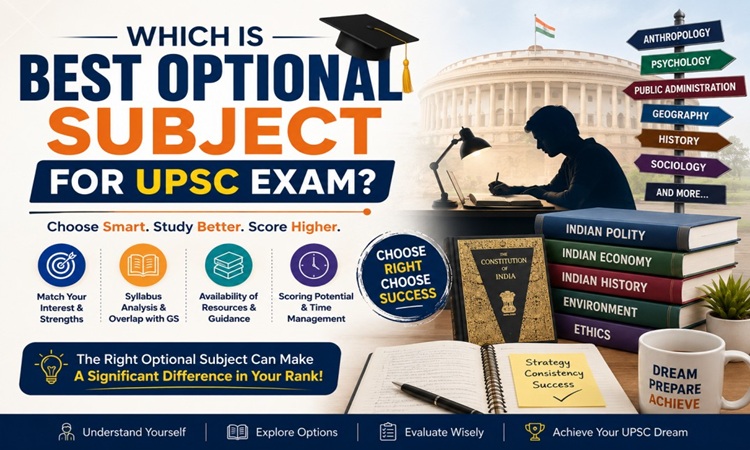
There are several factors to consider when choosing the best UPSC optional subject, including your academic background, interest in the subject, syllabus, availability of study material, and the time available for preparation. The UPSC optional subject syllabus is generally designed at a level between undergraduate and postgraduate studies. Choosing the right optional subject is one of the most important decisions in your UPSC Civil Services Examination journey, as it carries 500 marks in the UPSC Mains Examination and can significantly influence your final rank. If you are preparing through self-study, selecting an optional that matches your strengths, interests, and available resources becomes even more important. A well-chosen optional not only makes learning more effective but also improves consistency and confidence throughout your preparation. For aspirants seeking expert mentorship, structured study material, and regular answer-writing practice, joining the Best UPSC Coaching Institute in Delhi can provide the guidance and support needed to maximize performance in both the Optional Subject and General Studies.
Why is the UPSC Optional Subject Important?
The UPSC optional subject consists of Paper I and Paper II, each carrying 250 marks, making a total of 500 marks in the UPSC Mains Examination. While General Studies is common for all candidates, the UPSC optional subject allows aspirants to showcase their in-depth understanding of a particular discipline. A strong performance in the optional papers can create a significant advantage in the final merit list.
The Role of the Optional Subject in Final Selection
Many successful candidates have achieved top ranks because of exceptional scores in their optional subject. Therefore, selecting the right subject should be based on careful analysis rather than popularity or trends.
Common Mistakes While Choosing an Optional
Many aspirants choose an optional simply because it is considered “high scoring” or because friends have selected it. Every candidate has a unique academic background and learning style, making personal suitability far more important than market perception.
Factors to Consider Before Choosing an UPSC Optional Subject
Selecting the right optional requires evaluating multiple factors. Choosing the Best UPSC Optional Subject is a crucial step in your UPSC Civil Services preparation. As the optional subject carries 500 marks in the UPSC Mains Examination, your choice can have a significant impact on your overall rank. Instead of following trends or others’ recommendations, choose a subject that matches your interests, academic background, strengths, and preparation time. Carefully evaluating these factors will help you make an informed decision and build a strong foundation for success in the examination. Consider the following before making your decision.
1. Interest in the Subject
Interest is the most important factor for long-term preparation. If you genuinely enjoy reading the subject, you are more likely to remain motivated during months of study and revision.
2. Educational Background
Choosing a subject that you have already studied during graduation or post-graduation can reduce your learning curve. Familiarity with concepts often helps in better answer writing.
3. Availability of Study Material
A self-study candidate should ensure that standard books, previous year papers, topper notes, and online resources are easily available. Limited resources can make preparation difficult.
4. Length of the Syllabus
Some optional subjects have a relatively shorter syllabus, while others require extensive reading. Choose a subject that fits your preparation timeline and revision strategy.
5. Previous Year Question Papers
Analyze at least five to ten years of UPSC previous year question papers. This helps you understand the nature of questions and whether the subject suits your analytical abilities.
6. Overlap with General Studies
Subjects such as Political Science, Geography, Sociology, Anthropology, Public Administration, and History offer considerable overlap with General Studies and Essay papers, helping optimize preparation time.
Top 6 Best Optional Subject for UPSC Exam
There is no universally “best” optional subject for the UPSC examination. The right choice depends on your interests, academic background, and preparation strategy. However, subjects such as Political Science and International Relations (PSIR), Anthropology, Sociology, and Geography are popular among aspirants because they offer substantial overlap with the General Studies syllabus, have abundant study resources, and have been chosen by many successful candidates over the years.
1. Sociology
Sociology has a concise syllabus, straightforward concepts, and excellent overlap with Essay, Ethics, and General Studies. The Best Sociology Optional subject helps UPSC aspirants build strong conceptual clarity, master sociological thinkers, and connect theories with current issues. With expert faculty, structured study material, regular answer-writing practice, and comprehensive test series, aspirants can prepare systematically and improve their performance in the UPSC Mains Sociology Optional paper.
2. Political Science and International Relations (PSIR)
Choosing the right optional subject is a key step in UPSC CSE preparation. Political Science and International Relations (PSIR) is one of the most popular PSIR optional subjects due to its significant overlap with GS Papers I, II, III, and IV, allowing aspirants to strengthen both Optional and General Studies simultaneously. PSIR also develops analytical thinking, critical reasoning, and answer-writing skills that prove valuable in both the Mains Examination and the Personality Test. With expert guidance, a structured preparation strategy, and regular answer-writing practice, PSIR can become a high-scoring optional for UPSC aspirants. PSIR benefits candidates interested in governance, polity, international relations, and current affairs. It also overlaps significantly with General Studies Paper II.
3. Anthropology
The UPSC Anthropology Optional Syllabus consists of two papers. Paper I covers the basic concepts, theories, and methods of Anthropology, along with topics such as human evolution, society, culture, religion, kinship, and economic systems. Paper II focuses on Indian society and tribal communities, including their diversity, culture, problems, and development. With continuous mentorship and integration of relevant current affairs, students are guided to develop a strong strategy for scoring well in the UPSC Anthropology Optional paper.
4. Geography
Geography Optional is one of the most popular choices among UPSC aspirants due to its significant overlap with the General Studies syllabus. It covers both physical and human geography, offering a balanced mix of conceptual and analytical topics. Although the syllabus is extensive, the availability of quality study material, maps, current affairs integration, and regular answer-writing practice makes Geography a rewarding and high-scoring optional for the UPSC Civil Services Examination. Geography Optional combines physical and human geography with map-based learning. It also supports General Studies and Essay preparation.
5. Public Administration
The UPSC Public Administration Optional Syllabus is one of the 48 optional subjects offered in the Civil Services Mains Examination. It comprises two papers—Paper I and Paper II, carrying 250 marks each. Paper I focuses on administrative theories, concepts, and principles of public administration, while Paper II covers Indian Administration, including governance, public policies, and administrative systems. The syllabus helps aspirants develop a thorough understanding of government functioning, administrative processes, and public service delivery, making it highly relevant for future civil servants. Public Administration is useful for candidates interested in governance and administration. It also complements General Studies Paper II and Ethics.
6. History
The UPSC History Optional syllabus provides aspirants with a comprehensive understanding of historical events, socio-political developments, and their interpretations. It covers Ancient, Medieval, and Modern Indian History, along with World History, enabling candidates to develop a deeper understanding of historical processes, cultural evolution, and significant global transformations from an analytical perspective. History remains a preferred optional for aspirants who enjoy reading India’s ancient, medieval, modern, and world history.
How to Decide Whether an Optional is Right for You?
Choosing the right Optional Subject for UPSC is one of the most important decisions in Civil Services preparation. Since the optional papers carry 500 marks in the UPSC Mains Examination, the subject you choose can significantly influence your final rank. The ideal optional should match your academic background, interests, aptitude, and availability of study resources. By evaluating these factors carefully, aspirants can select a subject that suits their strengths and supports a focused, high-scoring preparation strategy. This guide will help you understand the key factors to consider while choosing the best optional subject for the UPSC Mains Examination. Before making your final decision, follow a structured approach:-
Read the Complete UPSC Syllabus
Preparing for the UPSC Civil Services Examination requires a thorough understanding of its extensive syllabus and a well-planned study strategy. The UPSC syllabus covers key subjects such as History, Geography, Indian Polity, Economy, Environment, Science & Technology, Ethics, Current Affairs, and International Relations. A clear understanding of these subjects, combined with regular revision, answer-writing practice, and mock tests, is essential for success in both the Prelims and Mains. This guide provides an overview of the important topics and concepts to help aspirants prepare systematically for the UPSC examination. Download and carefully analyze the official syllabus of your shortlisted subjects.
Study Sample Chapters
Read a few chapters from standard books to determine whether you enjoy the subject and understand its concepts.
Solve UPSC Previous Year Questions
Every year, lakhs of aspirants appear for the UPSC Civil Services Examination to secure prestigious positions in the Indian Administrative Service (IAS), Indian Police Service (IPS), Indian Foreign Service (IFS), and other Central Services. Among the most valuable preparation resources are the UPSC Previous Year Question Papers (PYQs), which help candidates understand the exam pattern, question trends, syllabus coverage, and the level of difficulty. On this page, you can download the last 10 years’ UPSC Question Papers PDF and learn how analyzing PYQs can strengthen your preparation strategy and improve your chances of success. Attempt previous year questions to assess your interest and answer-writing ability.
Evaluate Resource Availability
Ensure that quality books, online lectures, mock tests, and revision material are readily available.
Self-Study Tips for UPSC Optional Preparation
Build Strong Notes
Prepare concise and revision-friendly notes in your own words instead of relying entirely on printed material.
Practice Answer Writing
Write answers regularly and compare them with topper copies to improve presentation and analytical skills.
Revise Frequently
Multiple revisions improve retention and help reproduce concepts effectively during the examination.
Join a Test Series
Even self-study aspirants should consider joining an optional subject test series for evaluation and continuous improvement.
Can Coaching Help in Optional Subject Preparation?
Self-study is sufficient for many candidates, but guidance can simplify preparation. If you require expert mentorship, structured study material, answer-writing evaluation, and regular test series, institutes such as Vajirao & Reddy Institute provide optional subject guidance that complements self-study without replacing personal effort.
Conclusion
Choosing the best UPSC Optional Subject for self-study requires thoughtful planning rather than following popular trends. Evaluate your interest, educational background, syllabus length, availability of quality resources, and overlap with General Studies before making a decision. Once you select the right optional, focus on consistent study, answer writing, and regular revision. If you need expert guidance, mentorship, and structured preparation, enrolling in a Top IAS Coaching in Delhi can further strengthen your strategy and improve your overall performance. With discipline, smart planning, and the right approach, self-study combined with quality guidance can significantly enhance your chances of success in the UPSC Civil Services Examination.
Frequently Asked Questions (FAQs)
Which is the easiest UPSC Optional Subject for self-study?
There is no universally easiest optional subject. The best optional subject is one that matches your interest, academic background, and learning style.
Should I choose my graduation subject as an optional?
If you have a strong understanding of your graduation subject and enjoy studying it, it can be an excellent choice. However, interest and syllabus familiarity should remain the deciding factors.
Can I prepare for an optional subject without coaching?
Yes. Many UPSC toppers have successfully prepared their optional subject through self-study using standard books, previous year papers, online resources, and regular answer-writing practice.
Does the optional subject affect the final UPSC rank?
Yes. Since the optional subject carries 500 marks, it plays a crucial role in determining your final merit position.
