
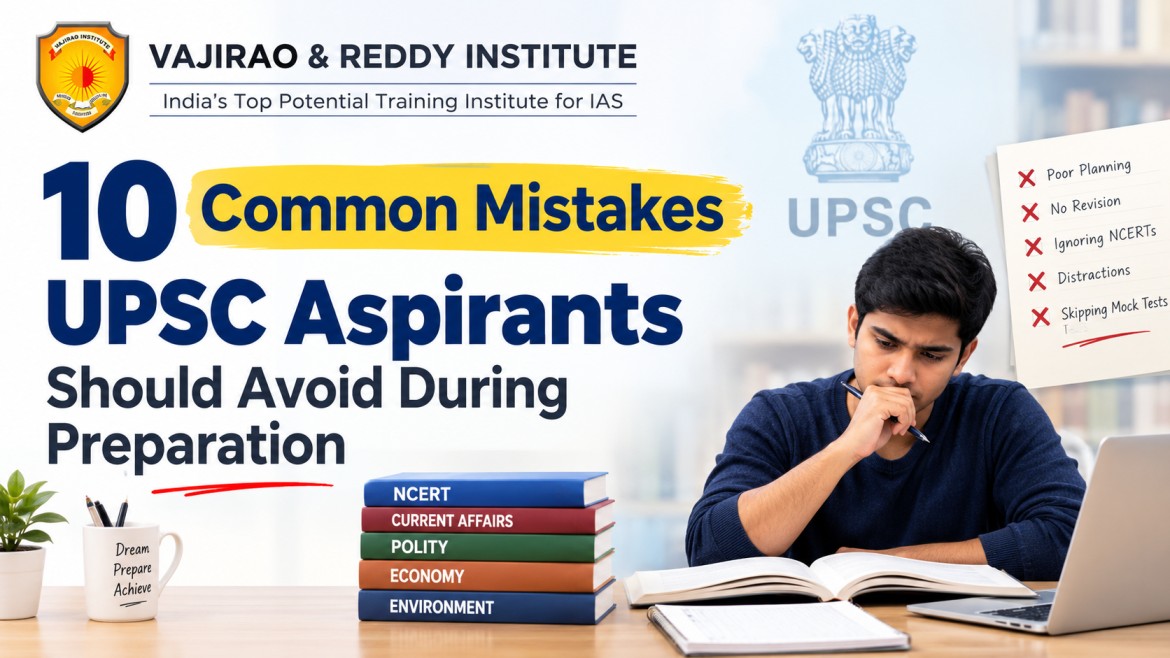
Every year, thousands of aspirants prepare for the UPSC Civil Services Examination (CSE) with the dream of becoming civil servants. Many students move to Delhi to access quality guidance and resources for their preparation. However, clearing the UPSC exam requires consistency, reliable study materials, a realistic timetable, and the habit of reading newspapers daily. Beginners often feel confused about what to study and how to organize their preparation. In many cases, the challenge is not a lack of hard work but an ineffective study strategy. Understanding the 10 common mistakes UPSC aspirants should avoid every year can help candidates stay focused, manage their time effectively, and prepare more systematically for the examination.
Top 10 Common Mistakes UPSC Aspirants Should Avoid During UPSC Preparation
Preparing for the UPSC Civil Services Examination (CSE) requires not only effective study habits but also the ability to identify and avoid common mistakes. Avoiding key preparation errors can help you use your time efficiently, stay focused, and improve your chances of success. Here are the 10 common mistakes UPSC aspirants should avoid to make their preparation more focused, organized and effective:-
1. Starting Without Understanding the UPSC Syllabus
Always start your UPSC preparation by understanding the syllabus. Read the UPSC syllabus carefully to understand what topics you need to study and plan your preparation effectively. Before picking up your books, take some time to read the UPSC Prelims and UPSC Mains syllabus. You do not have to memorise everything on the first day. Just understand the subjects and the broad areas you need to cover. Keep the syllabus handy and check it whenever you start a new topic. This simple habit can help you study with more clarity and avoid unnecessary reading.
2. Collecting Too Many Books
Many aspirants make the similar mistake of collecting too many books, instead of going for reliable sources. Well this is the first mistake made by many aspirants, but choosing the right books can make your preparation smooth, you don’t have to read too many books for the same content. It also makes your revision easy. So this is the pro tip for the beginners, don’t spend money purchasing the wrong book. Before buying books you can take help of youtube and online sources. There are many teachers and selected candidates who have advised which sources are best for the UPSC.
3. Studying New Topics and Revise
Have you ever felt confident after finishing a chapter, only to forget most of it when you return to it a week later? This is something many aspirants experience. UPSC Preparation involves so many subjects that you cannot expect to remember everything after reading it once. That is why revision needs to happen alongside your studies. You can spend a little time revisiting yesterday’s topics and set aside one day each week to revise what you have covered. Short notes can also help when you need to go through a topic quickly. The idea is to keep returning to what you have learned instead of constantly moving forward.
4. Read Newspaper Daily
For many beginners, reading the newspaper becomes a task that takes up a large part of the day. They try to read every page, make notes on every major headline and remember every new fact. Even after spending hours on it, they may struggle to recall what they have read. The solution is not to stop reading the newspaper but to be selective. Focus on news related to the UPSC syllabus, such as government policies, the economy, the environment, science and technology, and international relations. Try to understand why an issue is in the news and how it affects people or the country. You do not need to make notes on everything. A clear understanding of relevant issues is more useful than pages of notes that you rarely revise.
5. Don’t Ignore UPSC PYQs
Many aspirants spend months reading books before looking at previous years’ question papers. They assume that once they have covered the syllabus, they will automatically know how to answer the questions. Unfortunately, the actual examination may feel quite different from what they expected. UPSC Previous year Questions papers can help you understand how UPSC frames questions and tests concepts. Try solving questions after completing a topic instead of waiting until the end of your preparation. If you get an answer wrong, do not simply check the correct option and move on. Understand why you made the mistake. For Mains, notice what the question is asking you to explain, discuss or analyse. This will help you study with the examination in mind.
6. Don’t wait to Start Answer Practice
It is easy to tell yourself that you will start answer writing once you have finished the syllabus. But the syllabus is so vast that this moment may keep getting postponed. Reading and writing are two different skills. You may understand a topic well but still struggle to explain it clearly within the word limit. Start practicing with simple questions as soon as you have a basic understanding of a subject. Your first few answers may not be very good, and that is perfectly normal. Focus on answering the question directly, organizing your points and writing within the given time. Improvement comes with regular practice, not by waiting for the perfect moment.
7. Attempt Mock Test and Evaluate
Attempting mock tests can make you feel that your preparation is moving forward. However, the real learning often begins after the test, when you sit down to understand your mistakes. If you keep attempting tests without reviewing them, you may continue making the same errors. After each test, check which topics caused difficulty and why you selected the wrong options. Perhaps you misunderstood a concept, missed a key word in the question or made a guess without enough information. Even questions you answered correctly deserve a quick review if you were unsure about them. Use these observations to decide what you need to revise next.
8. Don’t make unrealistic Study Plan
At the beginning of preparation, you might plan to study for twelve hours every day, finish several chapters and revise everything at the weekend. The first few days may go well, but eventually, the schedule starts feeling exhausting. When you miss a target, you may feel that your entire plan has failed. Instead of following someone else’s timetable, make one that works for you. Consider how much time you actually have and how quickly you can understand a topic. Set daily targets that are challenging but realistic. If you are working or attending college, plan around those commitments rather than pretending they do not exist. You can always adjust your timetable as you learn more about your routine. What matters is following a plan consistently, not creating one that looks impressive.
9. Comparing Your Preparation With Other Aspirants
You open social media and see someone claiming to have completed the syllabus twice. Another aspirant has attempted hundreds of mock questions, while someone else shares a timetable that starts at five in the morning. After seeing all these things you start feeling pressurized. This is not the right way to compare, every aspirant has a different routine and schedule to follow, never try to copy. Instead, look at your own progress.
10. Ignoring Your Health While Preparing
Consistently studying is the important part of your preparation, but not taking care of your health is not a good idea, you should have balance between your study and health at the same time. Try to take possible breaks in between the long hours of study. Take proper 8 hours of sleep so that you wake up fresh and start your routine again. Your UPSC preparation is a long process, and you need a routine that you can maintain over time.
Conclusion
UPSC preparation is a time-consuming process, so patience and consistency are essential. There will be ups and downs, but you must follow your study schedule and stay focused on your goal. Start by reading the syllabus and creating a realistic daily study plan. Begin with NCERT books to build your basics, read the newspaper daily to stay updated on current affairs, and revise whatever you study at the end of each day. Solve previous years’ question papers (PYQs), start answer-writing practice for Mains early, and attempt mock tests regularly to evaluate your performance. If you need structured guidance, enrolling in the Best IAS Coaching in Delhi can help you follow a systematic preparation strategy with expert support and regular practice.

Vikash is a Current Affairs Expert specialising in UPSC and IAS exam preparation. He simplifies complex national and international developments into clear, exam-oriented insights. His content connects current affairs with the UPSC syllabus and focuses on analysis, facts, and answer writing to help aspirants prepare effectively for the Civil Services Examination.