
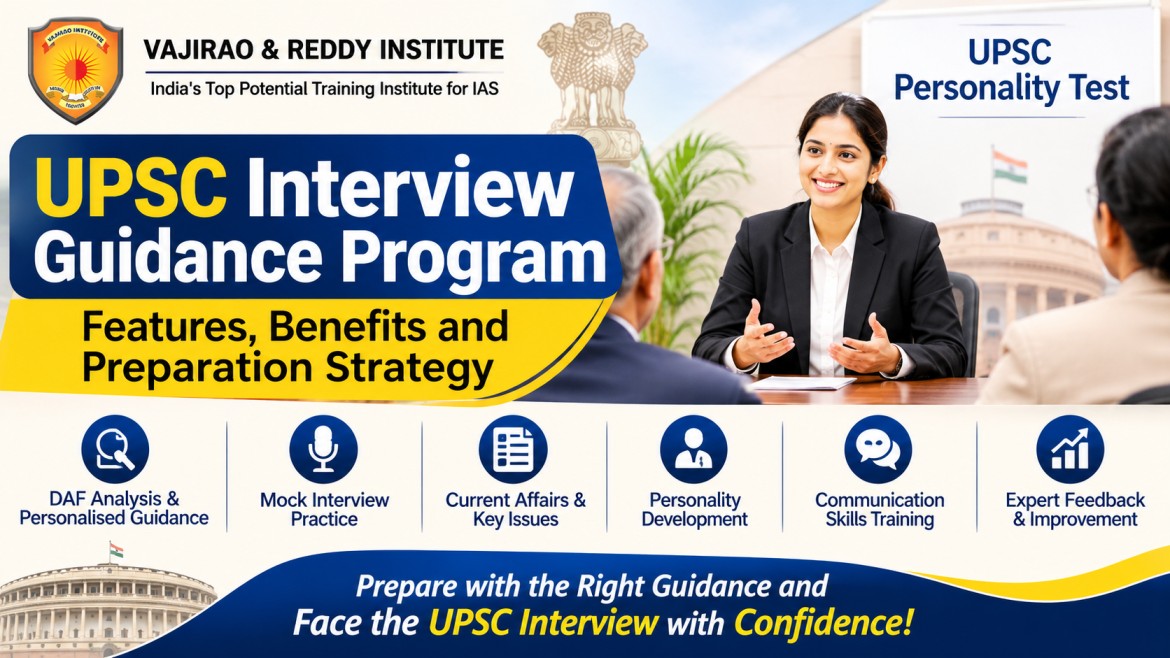
The UPSC Civil Services Personality Test, commonly known as the IAS Interview, is the final stage of the Civil Services Examination. After successfully clearing the UPSC Mains Examination, shortlisted candidates appear before a panel of experienced members appointed by the Union Public Service Commission (UPSC). Unlike the Preliminary and Main examinations, which primarily assess knowledge and analytical abilities, the Personality Test evaluates a candidate’s personality, judgement, communication skills, intellectual curiosity, decision-making ability, and suitability for a career in civil services.
Preparing for this stage requires more than simply revising current affairs or memorising facts. Candidates must develop a balanced understanding of national and international issues, their educational background, home state, hobbies, optional subjects, and personal experiences mentioned in the Detailed Application Form (DAF).
A structured UPSC Interview Guidance Program 2027 can help aspirants prepare systematically through DAF analysis, mock interviews, current affairs discussions, personality development sessions, and expert feedback. With the right guidance and consistent practice, candidates can approach the Personality Test with greater confidence, clarity, and composure.
This article explains the features, benefits, preparation strategy, and importance of choosing the right UPSC Interview Guidance Program for the 2027 Civil Services Examination.
What Is the UPSC Interview Guidance Program?
A UPSC Interview Guidance Program (IGP) is a specialised preparation programme designed for candidates who have qualified for the Civil Services Personality Test. It provides structured guidance to help candidates understand the interview process, anticipate questions, improve communication, and present their opinions confidently before the UPSC interview board.
The programme generally includes:
-
Detailed Application Form (DAF) analysis and personalised question preparation.
-
Mock interviews conducted by experienced panels.
-
Current affairs and important national and international issues.
-
Home state, educational background, and optional subject-based preparation.
-
Communication skills, body language, and personality development.
-
Feedback and performance evaluation after mock interviews.
-
Guidance on answering situational, ethical, and opinion-based questions.
The primary objective of an Interview Guidance Program is not to teach candidates scripted answers but to help them develop clarity of thought, balanced opinions, honesty, and a natural approach to answering questions.
UPSC Personality Test 2027: Important Details
The Personality Test is the final stage of the UPSC Civil Services Examination. Candidates who qualify for the Mains Examination are shortlisted for the interview based on the prescribed selection process.
| Particulars | Details |
|---|---|
| Examination | UPSC Civil Services Examination 2027 |
| Final Stage | Personality Test (Interview) |
| Interview Marks | 275 |
| Interview Board | UPSC-appointed panel |
| Interview Location | UPSC Office, New Delhi |
| Main Purpose | Assessment of personality and suitability for civil services |
| Final Merit | Mains Examination (1750) + Personality Test (275) |
The UPSC Personality Test carries 275 marks, making it an important component of the final merit list. Therefore, candidates should prepare for this stage with the same seriousness and planning as the Preliminary and Mains examinations.
Key Features of a UPSC Interview Guidance Program 2027
A comprehensive UPSC Interview Guidance Program should focus on individual preparation rather than providing the same set of questions and answers to every candidate. The following features are important for effective Personality Test preparation.
1. Detailed Application Form (DAF) Analysis
The Detailed Application Form (DAF) is one of the most important sources of questions during the UPSC Personality Test. It contains information about a candidate’s educational qualifications, hometown, state, hobbies, work experience, optional subject, and personal background.
A structured DAF analysis helps candidates identify potential questions and prepare relevant topics in advance.
Important areas covered during DAF analysis include:
-
Educational background and graduation subjects.
-
Home district, state, and regional issues.
-
Hobbies, interests, and extracurricular activities.
-
Work experience, if applicable.
-
Optional subject and its practical relevance.
-
Achievements, awards, and personal experiences.
Candidates should prepare for both factual and opinion-based questions related to their DAF. They should also understand how their educational and personal experiences connect with public administration and governance.
2. Personalised Mock Interview Sessions
Mock interviews are an essential part of UPSC Personality Test preparation. They provide candidates with an opportunity to experience a simulated interview environment and understand how to respond to questions from a panel. A good UPSC mock interview should include questions related to current affairs, DAF details, social issues, governance, ethical dilemmas, and situational judgement.
Mock interview sessions help candidates:
-
Improve confidence while interacting with an interview panel.
-
Develop clear and structured responses.
-
Practise handling unexpected questions.
-
Improve communication and presentation skills.
-
Identify weaknesses and areas requiring improvement.
Candidates should treat mock interviews as learning opportunities rather than attempts to predict the actual UPSC interview questions.
3. Current Affairs and Contemporary Issues Preparation
Current affairs play an important role in the UPSC Personality Test. Interview boards may ask candidates about recent national and international developments, government policies, economic issues, social challenges, and India’s foreign relations. However, candidates should focus on understanding issues rather than memorising news headlines. Important areas of current affairs preparation include:
-
Indian economy, inflation, employment, and economic growth.
-
Government policies, welfare schemes, and governance reforms.
-
International relations and India’s foreign policy.
-
Climate change, environmental protection, and sustainability.
-
Science and technology developments.
-
Internal security and contemporary social issues.
-
Constitutional developments and important judicial decisions.
Candidates should develop balanced opinions and understand different perspectives before expressing their views during the interview.
4. Home State and District-Based Preparation
Questions about a candidate’s home state, district, and hometown are common areas of preparation for the UPSC Personality Test. Candidates should prepare home state questions by understanding the geographical, historical, economic, cultural, and administrative characteristics of their region. For example, candidates from Rajasthan may be asked about water scarcity, desertification, tourism, agriculture, renewable energy, folk traditions, and state development initiatives. This preparation helps aspirants answer state-specific questions confidently and demonstrate a better understanding of regional issues and development challenges.
Preparation should cover:
-
Historical background and important personalities.
-
Geography, climate, rivers, and natural resources.
-
Economic activities, agriculture, and industries.
-
Cultural heritage, festivals, and traditions.
-
Major developmental challenges.
-
State government schemes and administrative initiatives.
Understanding local issues and suggesting practical solutions can help candidates demonstrate awareness of grassroots governance.
5. Communication Skills and Body Language Development
Effective communication is an important aspect of the Personality Test. Candidates should be able to express their thoughts clearly, listen carefully, and respond naturally without appearing overconfident or rehearsed.
A UPSC Interview Guidance Program should help candidates improve:
-
Verbal communication and clarity of expression.
-
Listening and comprehension skills.
-
Eye contact and appropriate facial expressions.
-
Posture, gestures, and overall body language.
-
Confidence and emotional composure.
-
Ability to communicate complex ideas in simple language.
Candidates should remember that the UPSC interview is a personality assessment, not a public speaking competition. Natural communication, honesty, and balanced responses are more important than using complicated vocabulary.
6. Ethical and Situational Question Preparation
The interview board may present hypothetical situations to evaluate a candidate’s judgement, integrity, administrative understanding, and ability to handle difficult circumstances.
For example:
-
How would you handle political pressure as a district administrator?
-
What would you do if a senior officer asked you to take an unethical decision?
-
How would you manage a situation involving communal tension?
-
How would you address corruption in a government department?
-
What steps would you take to improve public service delivery in a rural area?
Candidates should approach such questions logically by considering constitutional values, public interest, administrative rules, transparency, accountability, and practical constraints.
7. Personalised Feedback and Performance Evaluation
Feedback is one of the most valuable components of an Interview Guidance Program. After every mock interview, candidates should receive an assessment of their performance, including strengths and areas requiring improvement.
Feedback may cover:
-
Content knowledge and factual accuracy.
-
Clarity and relevance of answers.
-
Communication and presentation.
-
Confidence and composure.
-
Logical reasoning and decision-making.
-
Handling of difficult or unexpected questions.
Candidates should maintain a record of feedback and work on the identified weaknesses before appearing for the actual Personality Test.
Benefits of Joining a UPSC Interview Guidance Program
Preparing independently for the UPSC interview can be challenging because candidates may not always recognise their communication gaps, weaknesses, or areas of improvement. An organised guidance programme provides structured practice and expert assessment.
The major benefits include:
1. Structured and Focused Preparation
An Interview Guidance Program provides a systematic preparation roadmap covering DAF analysis, current affairs, mock interviews, and personality development. It helps candidates priorities important areas instead of preparing randomly.
2. Improved Confidence and Interview Readiness
Regular interaction with interview panels helps candidates become familiar with the interview environment. It reduces hesitation and improves their ability to communicate thoughts clearly under pressure.
3. Better Understanding of Personal Strengths and Weaknesses
Individual feedback helps candidates identify areas where they perform well and topics that require further preparation. This makes their preparation more focused and productive.
4. Exposure to Different Types of Questions
Mock interviews expose candidates to factual, analytical, opinion-based, ethical, and situational questions. This prepares them to handle a wider range of questions rather than relying on memorized answers.
5. Development of Balanced Opinions
Candidates learn to analyse issues from multiple perspectives, consider constitutional principles, and present practical solutions. This is particularly useful when answering questions related to governance, public policy, and contemporary developments.
6. Guidance from Experienced Mentors
Mentorship and expert discussions can help candidates understand the expectations of the Personality Test and improve their approach to answering questions.
7. Better Time Management During Preparation
A planned interview preparation schedule allows candidates to divide their time between DAF preparation, current affairs revision, mock interviews, and personality development.
UPSC Interview Preparation Strategy for 2027
A successful UPSC interview preparation strategy should focus on knowledge, awareness, communication, and personality development. Candidates should avoid preparing scripted answers and instead develop the ability to think independently. The following step-by-step approach can help aspirants prepare effectively.
Step 1: Analyse Your DAF Thoroughly
Begin your preparation by reviewing every detail mentioned in your Detailed Application Form. Identify possible questions related to your education, hometown, hobbies, work experience, and optional subject. Prepare a topic-wise list of probable questions and understand the background of each topic. Pay particular attention to information that may lead to analytical or opinion-based discussions.
Step 2: Develop a Strong Understanding of Current Affairs
Read newspapers and follow reliable current affairs sources regularly. Focus on understanding the background, causes, implications, and possible solutions related to important developments.
For every major issue, try to understand:
-
What is the issue?
-
Why is it important?
-
What are its major causes?
-
How does it affect society and governance?
-
What are the possible solutions?
This approach helps candidates develop informed and balanced opinions.
Step 3: Prepare Your Home State and District
Study your home state from geographical, historical, economic, political, and administrative perspectives. Understand major developmental challenges and important government initiatives. Candidates should also prepare questions about their hometown, local industries, famous personalities, cultural traditions, and regional issues.
Step 4: Practise Mock Interviews Regularly
Participate in mock interview sessions to evaluate your readiness. Practise answering questions in a natural and structured manner. After each session, review your performance and work on the feedback received. Focus on improving answer clarity, confidence, factual understanding, and composure.
Step 5: Improve Communication and Body Language
Practise expressing your views in simple and precise language. Develop the habit of listening carefully before answering. Maintain appropriate eye contact, a comfortable posture, and a calm expression. Avoid unnecessary hand movements, interruptions, and overly lengthy answers.
Step 6: Prepare for Difficult and Unexpected Questions
The interview board may ask questions that do not have straightforward answers. Candidates should remain calm and avoid guessing when they are unfamiliar with a topic. If you do not know an answer, politely acknowledge it instead of providing incorrect information. If a question seeks your opinion, explain your reasoning with clarity and balance.
Step 7: Revise Important Topics Before the Interview
During the final preparation phase, revise your DAF, important current affairs, home state information, government policies, and major national and international developments. Avoid starting too many new topics at the last moment. Focus on revision, confidence, and maintaining a calm mindset.
How to Choose the Right UPSC Interview Guidance Program?
Selecting an appropriate Interview Guidance Program is an important decision for candidates who have qualified for the UPSC Mains Examination. Aspirants should evaluate the programme based on the quality of guidance, individual attention, mock interview structure, and feedback mechanism.
Consider the following factors before joining:
| Selection Criteria | What Candidates Should Look For |
|---|---|
| DAF Analysis | Personalised analysis of educational, personal, and professional details |
| Mock Interviews | Realistic interview simulations with relevant questions |
| Faculty Guidance | Mentors with a strong understanding of the UPSC interview process |
| Current Affairs | Coverage of national and international developments |
| Personalised Feedback | Detailed evaluation after each mock interview |
| Communication Training | Guidance on speaking skills, confidence, and body language |
| Interview Environment | A professional and realistic mock interview setting |
| Study Resources | Relevant notes, question banks, and preparation material |
Candidates should choose a program that focuses on individual improvement rather than simply conducting multiple mock interviews. Effective UPSC Mock Interview Preparation should include personalized feedback, performance evaluation, communication skills development, DAF-based questions, and practical guidance to help candidates improve confidence and interview readiness.
UPSC Interview Preparation for Hindi Medium Candidates
Hindi-medium candidates should prepare for the Personality Test with the same focus on conceptual clarity, confidence, and balanced communication as candidates from other language backgrounds. Candidates can express their thoughts in the language permitted under UPSC interview rules. The objective should be to communicate ideas clearly rather than focus on vocabulary or accent. Important preparation tips for Hindi-medium aspirants include:
-
Practice expressing opinions clearly and confidently in Hindi.
-
Develop an understanding of important national and international issues.
-
Prepare DAF-based questions in the preferred interview language.
-
Practice mock interviews to improve communication and confidence.
-
Avoid memorizing lengthy answers.
-
Focus on logical reasoning and balanced opinions.
A supportive guidance program can help Hindi-medium candidates overcome hesitation and prepare confidently for the Personality Test.
Common Mistakes to Avoid During UPSC Interview Preparation
Even candidates with strong academic knowledge may face difficulties during the Personality Test if they do not prepare their communication and presentation skills. Some common mistakes to avoid include:
-
Memorising scripted answers: Rehearsed responses may sound unnatural and restrict independent thinking.
-
Ignoring DAF preparation: Candidates should be thoroughly familiar with every detail mentioned in their application form.
-
Giving extreme opinions: Responses should reflect balanced thinking, constitutional values, and practical understanding.
-
Guessing incorrect answers: It is better to acknowledge a lack of knowledge than provide misleading information.
-
Ignoring current affairs: Candidates should understand important developments and their wider implications.
-
Overlooking body language: Poor posture, unnecessary gestures, and lack of composure can affect communication.
-
Taking mock interviews casually: Candidates should analyze feedback and make continuous improvements.
Avoiding these mistakes can make interview preparation more focused, practical, and effective.
Prepare for UPSC Interview 2027 with the Right Guidance
The UPSC Personality Test is an opportunity for candidates to demonstrate their knowledge, maturity, intellectual curiosity, communication skills, and suitability for public service. Success at this stage requires a balanced combination of awareness, confidence, logical thinking, and an understanding of administrative responsibilities. A well-structured UPSC Interview Guidance Program 2027 can help candidates prepare through personalized DAF analysis, mock interview sessions, current affairs discussions, communication development, and expert mentorship. Vajirao & Reddy Institute provides guidance for UPSC Civil Services aspirants through structured preparation support and interview-oriented mentoring. Candidates preparing for the Personality Test can seek guidance to identify their strengths, improve their responses, and develop a confident approach to the interview.
Start your UPSC Interview Preparation with the right guidance, consistent practice, and a clear understanding of what the Personality Test expects.
Frequently Asked Questions (FAQs)
1. How many marks does the UPSC Personality Test carry?
The UPSC Civil Services Personality Test carries 275 marks. These marks are added to the 1,750 marks allocated for the Mains written examination to determine the final merit position.
2. When should I join a UPSC Interview Guidance Program?
Candidates should consider joining an Interview Guidance Program after qualifying for the UPSC Mains Examination. Starting preparation early allows sufficient time for DAF analysis, mock interviews, current affairs revision, and personality development.
3. How many mock interviews should I attend for UPSC preparation?
There is no fixed number of mock interviews prescribed by UPSC. Candidates should focus on the quality of practice, feedback, and improvement rather than completing a particular number of sessions.
4. Can Hindi-medium candidates join the UPSC Interview Guidance Program?
Yes. Hindi-medium candidates can join an Interview Guidance Program and practise expressing their thoughts confidently in their preferred interview language, in accordance with UPSC rules.
5. What is the difference between a UPSC mock interview and the actual Personality Test?
A mock interview is a simulated practice session conducted by mentors or an interview panel to assess preparation and provide feedback. The actual Personality Test is conducted by a UPSC-appointed board and forms part of the official Civil Services Examination selection process.
6. How can I improve my confidence for the UPSC interview?
Candidates can improve confidence through regular mock interviews, DAF-based preparation, current affairs discussions, communication practice, and feedback-based improvement. Understanding topics instead of memorising answers also helps candidates respond naturally.

Vikash is a Current Affairs Expert specialising in UPSC and IAS exam preparation. He simplifies complex national and international developments into clear, exam-oriented insights. His content connects current affairs with the UPSC syllabus and focuses on analysis, facts, and answer writing to help aspirants prepare effectively for the Civil Services Examination.