
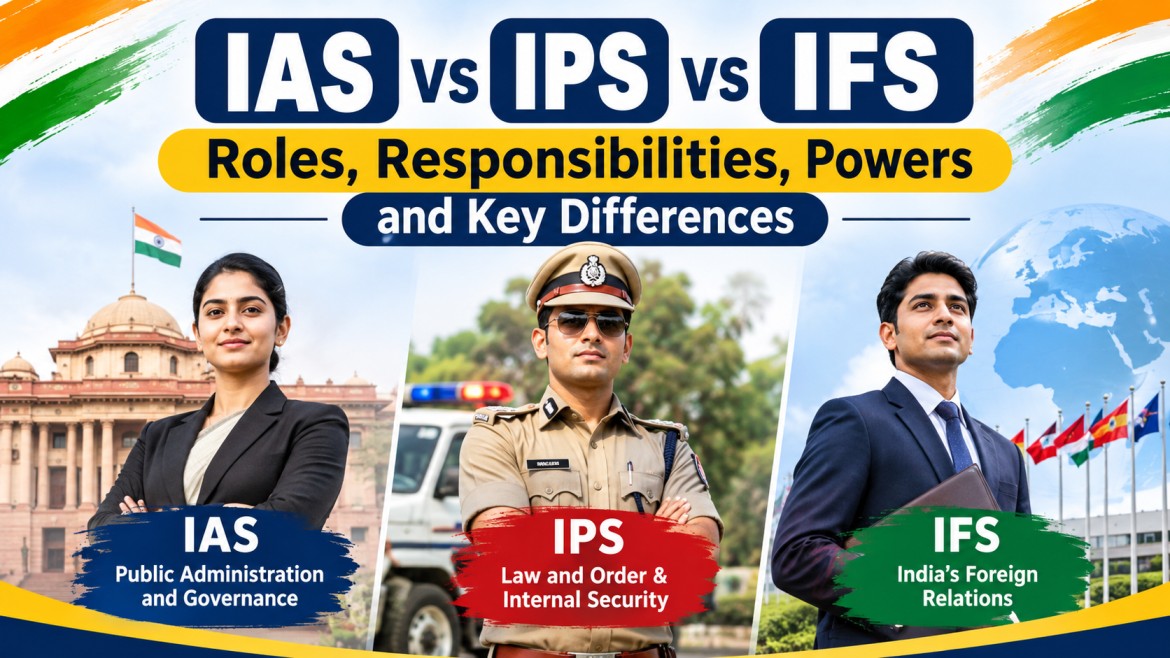
A number of aspirants take the UPSC Civil Services Examination to be able to work for the nation, especially to serve the citizens and make a difference in society by choosing any of the three prestigious services. Indian Administrative Service (IAS), Indian Police Service (IPS), and Indian Foreign Service (IFS). Many of them are not clearly aware of the differences in these services and the responsibilities, work environment, and career path, etc. Aspirants need to gain an understanding of these three services to be able to make a well-informed decision about their career. All three services recruit candidates through the UPSC Civil Services Examination, but their functions differ significantly. IAS officers manage governance and public administration, IPS officers maintain law and order and oversee internal security, while IFS officers represent India and strengthen its diplomatic relations with other nations.
What are the Indian Civil Services?
The Indian Civil Services are known for implementing policies and schemes of the Government of India and for being in charge of the effective functioning of the machinery of the Government to address the issues and concerns of the citizens of India there is a well-defined and well-organized administrative system in the country. The System works at the grassroots level in the districts of the country and at the center in the different ministries of the Government. The Indian Civil Services work in all these sectors.
Responsibilities of the Indian Civil Services include public policy, public safety, social services, international relations, etc. The Indian Administrative Service (IAS), the Indian Police Service (IPS) and the Indian Foreign Service (IFS) are the three prominent services for which candidates prepare for the UPSC Civil Services Examination. Though these services have varying responsibilities, their ultimate aim is to serve the country and its citizens. For instance, an IAS officer may work as the District Collector while an IFS officer may work in one of the Indian missions abroad.
1. Indian Administrative Service (IAS)
The Indian Administrative Service (IAS) is one of the three all-India services and is perhaps the most coveted service for UPSC (Union Public Service Commission) exam aspirants. The primary duty of IAS officer is to manage the administrative affairs of the government at the state and central level. IAS officers work at the core to provide the services of the government and implement various social welfare program. Their duties require them to interact with other bureaucratic agencies, coordinate the work of several departments, and review development works.
Different Responsibilities at Different Levels
Different levels of the government have different responsibilities. In the state government, IAS officers can be the district magistrate or the deputy commissioner. At this level, an officer is entrusted with the responsibility of looking into the public order and matters relating to development. Officers at this level may have to coordinate with field-level officers in the district, review the functioning of the department, and address the issues of public concern. In case of natural calamities, IAS officers are also involved in the relief and rehabilitation work. A similar role can be played by an IAS officer during elections. The above responsibilities can change depending on the requirements of the government and where the officer is posted.
2. Indian Police Service (IPS)
The Indian Police Service (IPS) is another important All India Service recruited through the UPSC Civil Services Examination. Officers of the Service are trained to manage the maintenance of law and order, prevention of crimes, and protection of public safety. It is a challenging service, as officers deal with crime and security-related issues. It requires courage and leadership, and the ability to make crucial decisions under pressure.
The Role of an IPS Officer
An IPS Officer at the district level in India may serve as the Superintendent of Police (SP) or in some other similar ranking police position, depending upon the state and the posting. The SP supervises police stations and reviews crime-related work. SPs liaise with other government departments for maintenance of law and order. SPs may be required to prevent public gatherings and crimes, and to oversee security during elections and other sensitive and important work. IPS officers are also charged with responsibility to review and strengthen the investigative methods of the police and to ensure adherence to the provisions of the Code of Criminal Procedure during police proceedings.
3. Indian Foreign Service (IFS)
The Indian Foreign Service, or IFS, is involved in representing India overseas and managing India’s international relations. IFS officers work to safeguard India’s interests and develop healthy relationships with foreign governments. They are posted in Indian embassies, high commissions, and consulates. Their work involves negotiations and communication through different channels of international diplomacy, trade relations, as well as looking after the welfare of Indian citizens overseas. Unlike officers of the IAS and IPS, IFS officers spend a major portion of their career outside India.
Roles and Responsibilities of an IFS Officer
Representation of India on the international scene is the prime responsibility of an IFS officer. Communication with foreign governments and participation in international meetings to brief on issues of concern to India are part of their responsibilities. Development and fostering of international relations in the field of trade and commerce, culture, education, and technology are also part of their duties. Understanding of international relations and politics and ability to communicate effectively are essential to the job. They represent the country in discussions on relevant issues.
What is the Difference Between IAS, IPS and IFS?
UPSC aspirants tend to get perplexed between IAS, IPS and IFS services as all the services, in general, indicate a good and prestigious career in the government. However, the core functions and responsibilities of each service are vastly different. The key difference is that IAS officers work at different levels of state administration and implement various Government of India policies, while IPS officers function at different levels of state police services and strive to prevent crime, ensure the investigation of crimes, and provide internal security, while IFS officers serve at different levels of the Indian Foreign Service and function in various Indian missions abroad. Each of these three services, in general, concentrates on different skills and know-how and develops those skills in their respective field of work.
The work environments in each of these services are different. An IAS officer may work in a district, state, or central level office; an IPS officer works in a district or state police office or a central security office; and an IFS officer in the Ministry of External Affairs or in an Indian mission abroad. IAS and IPS officers generally function in India and at times interact with officials of other countries, while IFS officers work at various Indian missions abroad and interact with officials of other countries.
Which Service Should You Choose?
IAS, IPS and IFS offer distinct services, opportunities and challenges. No service is better than the other. Your interests and career expectations determine your choice of service. Some may wish to work at the grassroots level for district development and may go for IAS. Some may look for challenges in law and order and may opt for IPS. Similarly, those interested in India’s International relations may choose IFS. Apart from interests and expectations, one should find out about various facilities offered by the services, nature of training, duties, and career prospects. Every service has its challenges, and an aspirant should consider these challenges as part of service before making a choice. As a civil servant, one should be accountable and disciplined at all times. Understanding all this helps a candidate to choose a service as per one’s interests, expectations, and career goals.
Conclusion
IAS, IPS and IFS shape India’s administration, internal security and international relations, making them vital services for the country’s development. Each service offers a valuable opportunity to serve the nation. Aspirants should clearly understand the roles, responsibilities and expectations associated with these services before beginning their UPSC preparation. Since the Civil Services Examination requires a comprehensive understanding of various subjects, a well-planned preparation strategy and consistent guidance are essential. This is where choosing the Best IAS Academy in Delhi becomes important. A reputed IAS coaching institute can help aspirants strengthen their conceptual understanding, follow a structured study plan, practice answer writing, assess their performance through regular tests and receive guidance from experienced faculty.

Vikash is a Current Affairs Expert specialising in UPSC and IAS exam preparation. He simplifies complex national and international developments into clear, exam-oriented insights. His content connects current affairs with the UPSC syllabus and focuses on analysis, facts, and answer writing to help aspirants prepare effectively for the Civil Services Examination.