
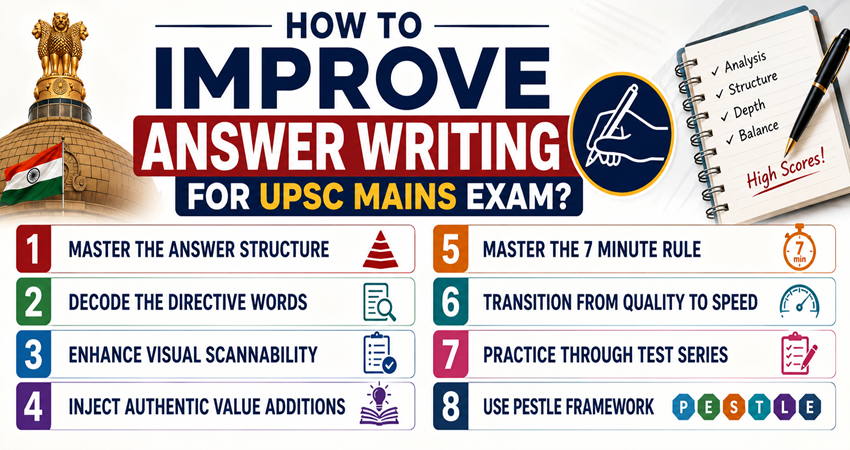
Improve your UPSC Mains answer writing with structured practice and smart time management. Learn the I-B-C (Introduction, Body, Conclusion) approach, master answer presentation, follow ideal time limits and accurately address directive words to boost your UPSC Mains score.
One of the greatest challenges faced by UPSC CSE aspirants is answer writing in the UPSC Mains Exam. This strategy provides a practical approach to developing the skills needed to write clear, concise, and high-scoring answers. Lakhs of aspirants are going to appear for the upcoming UPSC Mains examination. The time is very critical and there is room for no mistakes as the Mains examination is known to be one of the most intense stages of the Civil Service Examination. Many aspirants struggle to score well because their answer writing skills are not up to the mark. In a descriptive examination like UPSC Mains, the examiner evaluates not only the content of their answer but also its structure, clarity, relevance and presentation. Therefore it’s very important to write quality answers in the UPSC exam.
To improve answer writing for UPSC Mains aspirants should master the answer structure, decode the directive words in questions, enhance visual scannability, quote authentic sources in the answers, master the 7 minute rule to build speed & mental discipline, transition from quality to speed, practice through test series and use PESTLE framework. To analyse the quality of answer writing practice, aspirants should check alignment of the answers, look at visual architecture, check data density and create a scoreboard. Working on answers writing quality requires discipline and intensive practice. Despite the pressure of General Studies subjects, aspirants should dedicate a considerable amount of time to answer writing practice.
What is UPSC Mains Examination?
The UPSC Mains Examination is the second stage of the UPSC Civil Services Examination in India. It is a descriptive written test which is designed to test an aspirant’s intellectual depth, analytical skills and comprehensive understanding of various subjects. The UPSC Mains exam allows aspirants to shore their opinions on numerous administrative challenges. The UPSC Mains Exam consists of 9 papers which includes language papers, general studies papers, optional subject papers and an essay paper. All answers must be written in the language medium selected by the candidate such as English or Hindi.
Top 8 Tips to Improve Answer Writing for UPSC Mains Exam
The basics section covers the core principles of effective answer writing for the UPSC Mains Exam. These foundational elements are the minimum requirements every aspirant must master. A good answer is not just informative. It must be clear, concise, and strategically presented to gain an edge over other candidates. To improve your UPSC Mains Answer Writing, aspirants should master the answer structure, decode the directive words in questions, transition from speed & quality, practice through test series and use the PESTLE framework. Let’s understand how to improve answer writing for UPSC Mains exam quickly:-
1. Master the Answer Structure
Mastering UPSC Mains answer writing requires a balanced combination of well-structured, multi-dimensional content and clear, examiner-friendly presentation. High scores are achieved by accurately addressing the directive words in the question, maintaining strict time discipline, and following the Introduction-Body-Conclusion (IBC) framework. Consistent practice of these fundamentals helps aspirants write concise, analytical, and impactful answers. Every answer must follow a specific structure that helps the examiner grade it easily. Introduction should define the core term in the question and state a recent current affairs and statistic related to the topic. The body should address the core demands of the question.
2. Decode the Directive Words
Understanding UPSC directive words such as Critically Examine, Discuss, and Evaluate is crucial for scoring well in the Mains Examination. These keywords define the examiner’s expectations and guide how you interpret the question, organize your arguments, present analysis, and arrive at a balanced conclusion. Accurately addressing directive words ensures that your answer remains focused, relevant, and aligned with the demands of the question. Follow the Best Answer Writing Tips by structuring responses effectively, addressing directive words, adding relevant examples, managing time wisely, and practicing regularly to improve UPSC Mains performance. While answering, aspirants should decode the directive words, provide a 360 degree view and present arguments both for and against along with supporting evidence. They should give a deep dive into the hidden pros and cons.
3. Enhance Visual Scannability
Visual scannability plays a crucial role in UPSC Mains answer writing, as it enables examiners to quickly identify key arguments, facts, and the overall structure of your response. To enhance readability and presentation, aspirants should adopt techniques such as using short paragraphs, bullet points, clear subheadings, strategic underlining, diagrams, flowcharts, adequate spacing, and varied sentence structures. These Answer Writing for UPSC practices make answers more organized, engaging, and examiner-friendly, increasing their overall impact. Aspirants should write the arguments in bullet points to enhance visual scannability. They should keep each point short and start with a strong keyword. They should use quick flowcharts, mind maps and cycle diagrams to explain complex processes and multi dimensional impacts rapidly.
4. Inject Authentic Value Additions
UPSC Mains answer writing is not merely about responding to a question; it is about demonstrating analytical depth, balanced judgment, and multidimensional thinking. High-scoring answers go beyond basic facts by incorporating meaningful value additions such as Constitutional provisions, relevant data, committee recommendations, case studies, reports, and current affairs examples. When integrated into a clear and well-structured format, these elements enhance the quality, credibility, and overall impact of the answer. Aspirants should quote official sources such as the Economic Survey, National Family Health Survey and global rankings. In answers related to Polity, aspirants should always cite specific Constitution Articles and landmark Supreme Court judgements.
5. Master the 7 Minute Rule
Mastering effective UPSC Time Management is essential for completing the UPSC Mains Examination within the allotted duration. Aspirants should develop the ability to write concise, well-structured answers within a fixed timeframe while maintaining quality and analytical depth. Regular timed practice helps improve writing speed, enhances answer presentation, and ensures that every question receives adequate attention during the examination. UPSC aspirants should start by picking just one UPSC Previous Year Question Paper in a day and spend 1 minute listing the subheadings and points to write. They should set a strict timer for 7 minutes and force themselves to stop writing when it goes off. This builds speed and mental discipline quickly.
6. Transition from Quality to Speed
Moving from merely improving answer quality to mastering writing speed is a crucial step toward success in the UPSC Mains Examination. The challenge lies in maintaining both quality and efficiency while completing the paper within the allotted time. Aspirants must develop the ability to write approximately 4,000 words in 180 minutes, allocating around 7 minutes for a 10-mark question and 10–11 minutes for a 15-mark question. Consistent timed practice is essential to achieve this balance and maximize overall scores. Aspirants should pick a previous year question paper and research it thoroughly. They should write the absolute best answer they can with a timer. This approach will help aspirants transition from quality to speed.
7. Practice Through Test Series
Evaluating the quality of your answer-writing practice is essential for success in competitive examinations such as the UPSC Civil Services Mains. A comprehensive assessment should focus on key aspects such as answer structure, content relevance, analytical depth, time management, and overall readability. Regular evaluation across these parameters helps identify strengths, address weaknesses, and steadily improve answer-writing performance. Joining a UPSC Test Series helps to master answer writing practice. However, simply writing tests and reading solutions will not increase the score. Aspirants must treat the test series as a diagnostic tool to fix specific behavioral and academic limitations.
8. Use PESTLE Framework
The PESTLE framework is an effective tool for enriching UPSC Mains answers with a multidimensional and holistic perspective. By examining an issue through Political, Economic, Social, Technological, Legal, and Environmental dimensions, aspirants can present balanced and comprehensive analyses. This approach reflects the broad, interdisciplinary outlook expected from a civil servant and helps ensure that answers address complex issues from multiple angles. Aspirants should apply the PESTLE framework and analyse an answer from various dimensions such as Political, Economic, Social, Technological, Legal, Environmental to come up with insights to enhance the answers.
How to Analyse the Quality of Answer Writing Practice
An effective UPSC Mains answer-writing strategy involves understanding the demand of the question, organizing the response in a logical structure, and enriching the content with relevant examples, facts, case studies, diagrams, and current affairs references. This approach helps present answers in a clear, analytical, and scoring manner. To analyse the quality of answer writing practice, aspirants should check the alignment, look at the visual architecture, check data density and create a scoreboard. Let’s understand how to analyse the quality of answer writing practice:-
1. Check Alignment
While writing answers, aspirants should look at their subheadings and check if they actively repeat and directly address the specific split. If a question asks for causes and remedial measures then they must have one explicit subheading for causes and one for measures. To Crack UPSC Mains in 3 months, regularly analyze your answer-writing quality by assessing structure, content relevance, presentation, time management, and adherence to the question’s demand and directives.
2. Look at Visual Architecture
Visual architecture in answer writing refers to the strategic organization and presentation of content to make it easy for evaluators to read, understand, and assess. By using headings, subheadings, bullet points, flowcharts, tables, and diagrams, aspirants can transform lengthy text into well-structured, visually appealing and multidimensional answers that enhance clarity and impact. Aspirants should avoid dense paragraphs and work on the visual architecture of the answers. UPSC aspirants should observe whether they are able to spot at least 3-4 underlined words and a small diagram on every single page.
3. Check Data Density
Data density refers to the effective inclusion of relevant facts, figures, examples, and multiple dimensions within a limited word count. In competitive examinations like the UPSC Civil Services Mains, high data density is a key characteristic of top-scoring answers, as it enhances analytical depth, improves content quality, and ensures maximum value without exceeding prescribed word limits. The answers should never be vague and should include relevant data. Aspirants should check the data density and observe if every paragraph has some important data to support the answer or not.
4. Time and Space Efficiency
Time and space efficiency in UPSC answer writing refers to the ability to present maximum relevant information within the prescribed time and word limits. Evaluating these aspects helps aspirants determine how effectively they communicate key points, maintain content density, and structure answers concisely. A well-balanced approach ensures comprehensive coverage of the question while optimizing both writing speed and answer quality. High quality answer writing respects time and reflects space efficiency. Not sticking to them indicates poor planning. If aspirants write a brilliant and deeply researched answer but take 15 minutes to complete a 10 marker question, it is technically a low quality attempt.
5. Create a Scoreboard
To assess the effectiveness of your UPSC Mains answer-writing practice, use a structured scoring rubric. Evaluate each answer across five key parameters and assign a score of 0-2 for each criterion (0 = Needs Improvement, 1 = Satisfactory, 2 = Excellent). The cumulative score out of 10 provides a clear measure of your answer quality and helps identify areas that require further improvement. It is advisable that aspirants create a scoreboard for the next 5 practice answers. Aspirants should score themselves from 1 to 5 on the scoreboard before checking the model answers. Students preparing at Top IAS Institutes in Delhi can improve UPSC Mains performance by regularly evaluating answer quality, focusing on structure, content depth, presentation, and time management.
Conclusion
Answer Writing for UPSC Mains exam can drastically help enhance scores. To improve answer writing for UPSC Mains exam, aspirants should transition from quality to speed, practice through test series, use PESTLE framework, master the answer structure, decode the directive words, enhance the visual scannability, use authentic sources of data and master the 7 minute rule while writing answers. To analyse the quality of answer writing practice, aspirants should check the alignment, look at visual architecture, check data density, create a scoreboard and stick to time and space efficiency.
