
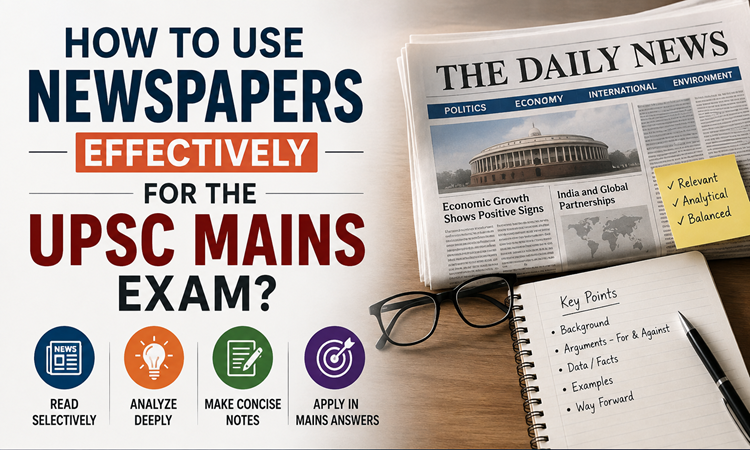
Preparing for the UPSC Mains examination requires more than reading standard books and study materials. Newspapers play an important role in helping aspirants understand current affairs, develop analytical thinking, and connect contemporary issues with the UPSC syllabus. However, reading a newspaper without a proper strategy can consume valuable preparation time. The key is to read selectively, make concise notes and connect important news with the demands of the UPSC Mains examination. To use newspapers effectively for the UPSC Mains examination, aspirants should choose one reliable national daily, such as The Hindu or The Indian Express and follow it consistently. Every important news article should be linked directly to the General Studies (GS I-IV) syllabus to ensure focused UPSC Mains preparation. Instead of concentrating on individual events, candidates should analyze the broader issues, including their causes, implications, challenges, and solutions. Editorials should be converted into concise, multi-dimensional notes that cover different perspectives and provide a structured framework for answer writing.
What is the UPSC Mains Exam?
The UPSC Mains Examination is the second and one of the most crucial stages of the Civil Services Examination conducted by the Union Public Service Commission (UPSC). It assesses candidates on their depth of understanding, analytical and critical-thinking abilities, and written expression through nine descriptive papers carrying a total of 1,750 marks. The UPSC Mains Paper is the second and most crucial stage of the Civil Services Examination conducted by the Union Public Service Commission (UPSC). It evaluates candidates’ knowledge, analytical ability, critical thinking, and answer-writing skills. The examination consists of nine descriptive papers, including Essay, General Studies, and Optional Subject papers. Two language papers are qualifying, while seven papers contribute to the final merit ranking. Candidates must demonstrate a clear understanding of concepts, balanced arguments, relevant examples, and effective presentation. Success in Mains requires consistent preparation, regular answer writing, revision, current affairs analysis, and a structured approach aligned with the UPSC syllabus. Lets a look at the UPSC Mains Exam Format:-
Descriptive Format
Similar to the objective-based UPSC Prelims. The UPSC Mains examination requires candidates to write detailed, analytical answers within a three hour time limit for each paper. The UPSC Mains Exam is the second and most important written stage of the Civil Services Examination conducted by the Union Public Service Commission (UPSC). UPSC Mains consists of nine descriptive papers, with seven papers contributing 1,750 marks to the final merit list. The examination evaluates a candidate’s depth of knowledge, analytical ability, critical thinking, and UPSC Mains answer writing skills. Unlike objective tests, UPSC Mains focuses on conceptual understanding, balanced arguments, relevant examples and effective presentation. Candidates need to connect current affairs with the syllabus and present clear, well-structured answers within the prescribed word limit. Consistent answer writing and revision are essential for success.
Qualifying Language Papers
UPSC Mains Exam Qualifying Paper (300 marks each) include Paper A (Indian Language) and Paper B (English). Candidates must secure a minimum of 25% marks in each paper to qualify. However, The marks obtained in these papers are not considered for the final merit ranking.
Papers Counted for Merit (1,750 Total Marks)
- Essay: 250 marks
- General Studies Paper I: 250 marks (Indian heritage, culture, history, and geography)
- General Studies Paper II: 250 marks (Governance, Constitution, polity, social justice, and international relations)
- General Studies Paper III: 250 marks (Economy, science and technology, environment, agriculture, and internal security)
- General Studies Paper IV: 250 marks (Ethics, integrity, and aptitude)
Total Marks for the Essay and General Studies Papers: 1,250 Marks
- Optional Subject Paper I: 250 marks
- Optional Subject Paper II: 250 marks
Total marks considered for the final merit ranking: 1,750 marks.
Tips for How to Use Newspapers Effectively for the UPSC Mains Exam
To use newspapers effectively for the UPSC Mains exam, focus on syllabus-linked topics, especially GS Paper II (Polity and International Relations) and GS Paper III (Economy and Environment). Limit newspaper reading to 60-90 minutes daily. Read editorials to understand different arguments and perspectives. Prepare concise, bullet-point notes with facts, examples, data, and solutions instead of copying entire paragraphs. Lets a look at the tips How to Use Newspapers Effectively for the UPSC Mains Exam:-
What to Read and What to Skip
To use newspapers effectively for the UPSC Mains Exam, read selectively and map relevant articles to the General Studies (GS I-IV) syllabus. Focus on important issues rather than isolated events. Identify multiple perspectives, key arguments, data, examples, and possible solutions.
Must-Read Sections
- Editorials and opinion columns
- Explained and analytical articles
- National and international policy developments
- Important government schemes and policy changes
What to Skip
- Local crime reports
- Political gossip and sensational news
- Regional political disputes
- Commercial advertisements
Newspaper Choice
Follow one primary newspaper consistently, such as The Hindu or The Indian Express. Avoid reading multiple newspapers to prevent information overload.
Mapping News to the GS Syllabus
Treat current affairs as dynamic case studies and practical examples rather than isolated facts. Connect each important news item with relevant static syllabus keywords and concepts. This approach helps build a deeper understanding of issues and makes current affairs more useful in UPSC Mains answers. Instead of creating separate notes for every article, organize information around broader themes and syllabus topics for easier revision and effective value addition.
GS Paper I
Focus on Indian society, social issues, women’s empowerment, population trends, art and culture, and modern history.
GS Paper II
Track governance, constitutional issues, Supreme Court judgments, government policies, international relations, and bilateral agreements.
GS Paper III
Focus on economic developments, infrastructure, agriculture, environmental issues, climate change, science and technology, and internal security.
GS Paper IV
Identify ethical dilemmas, administrative challenges, governance case studies, integrity issues, and examples of ethical decision-making.
Why Newspaper Reading Matters for UPSC Mains?
Newspapers provide real-time examples that can enrich answers across General Studies papers and the Essay paper. Choosing the Best Newspaper for UPSC Preparation helps aspirants understand government policies, economic developments, social issues, environmental concerns, international relations, science and technology, and important constitutional debates. Regular newspaper reading also develops the ability to examine issues from different perspectives. This analytical approach is essential for writing balanced, relevant, and well-structured UPSC Mains answers. Aspirants should focus on quality sources and consistent reading rather than following multiple newspapers. Lets a look at why news paper reading matter for UPSC mains:-
Connects Current Affairs with the UPSC Syllabus
Newspapers help candidates relate daily events to General Studies topics such as polity, governance, the economy, international relations, science and technology, and the environment. This approach makes it easier to understand concepts and apply them in the Mains examination.
Improves Analytical and Answer-Writing Skills
Editorials and opinion articles encourage aspirants to analyze issues from multiple perspectives. Regular reading helps candidates develop the ability to write balanced, well-structured, and evidence-based answers in the UPSC Mains examination.
Provides Facts, Data and Case Studies
Newspapers are valuable sources of reports, government initiatives, committee recommendations, statistics, and real-life examples. Including these elements in answers strengthens arguments and improves the overall quality of Mains responses.
Supports Essay and Interview Preparation
Regular newspaper reading helps candidates develop informed opinions on important issues affecting society, governance, and the economy. It also improves communication skills and broadens perspectives, which are essential for both the Essay paper and the UPSC Personality Test.
Choose the Right Newspaper for the UPSC Mains Exam
The Hindu and The Indian Express are widely recommended national newspapers for UPSC Mains preparation. They provide comprehensive coverage of important national and international issues. For aspirants choosing the Best Newspaper for UPSC Preparation, following one reliable newspaper consistently is more effective than reading multiple sources. This helps avoid information overload and saves valuable study time. While reading, candidates should map relevant articles to the General Studies (GS) syllabus and prepare concise, topic-wise notes. This approach improves retention, strengthens conceptual understanding, and enhances analytical skills for effective UPSC Mains answer writing.
Focus on Quality, Not Quantity
Aspirants do not need to read multiple newspapers every day. One reliable national newspaper, supported by a good current affairs source, is generally sufficient. The objective should be to understand important issues rather than collect excessive information.
Keep the UPSC Syllabus in Front of You
The Latest UPSC Mains syllabus should be your filter while reading the newspaper. Ask yourself whether a particular news item has a direct or indirect connection with the syllabus. If it does not contribute to your preparation, skip it and save valuable time.
What to Read in the Newspaper?
For UPSC Mains preparation, read reliable newspapers such as The Hindu and The Indian Express. Focus on issues rather than events. Understand the background, key arguments, relevant data, challenges, and the way forward. Link each issue with the relevant General Studies (GS) syllabus instead of memorizing temporary facts. Pay particular attention to:-
- Government schemes and policies
- Supreme Court and constitutional developments
- Parliament and important legislation
- Economic developments and policy decisions
- International relations and diplomacy
- Environment and climate change
- Science and technology developments
- Social issues and welfare
- Important reports, indices, and data
- Editorials discussing significant national and international issues
Avoid spending excessive time on celebrity news, routine political statements, local crime reports, sensational stories, and political controversies unless they have a clear connection with the UPSC syllabus.
How to Read Editorials for UPSC Mains?
To read editorials effectively for UPSC Mains, map each article to the relevant General Studies (GS) syllabus. To Prepare from Editorial Page Newspaper for UPSC Mains, identify multi-dimensional arguments, including both pros and cons, and note key facts, data, examples, and possible solutions. Prepare concise notes in your own words instead of copying the editorial. Limit daily newspaper reading and focus on important issues rather than isolated events.. Lets a look at How to Read Editorials for UPSC Mains:-
Connect Current Affairs with Static Subjects
One of the most effective newspaper-reading strategies is connecting current affairs with static subjects. If you read about a constitutional issue, revise the relevant constitutional provisions. If the news discusses inflation, revisit monetary policy and basic economic concepts.
This integration strengthens conceptual understanding and gives you contemporary examples that can make Mains answers more relevant.
Use Current Affairs in UPSC Mains Answers
The ultimate purpose of newspaper reading is to improve answer writing. Guidance from experienced UPSC Faculty can help aspirants identify relevant current examples, statistics, case studies, government initiatives, and recent developments to support their arguments. However, avoid forcing current affairs into every answer. Information should be relevant to the question and used to strengthen your argument rather than simply demonstrate that you have read the news. This approach helps develop concise, analytical, and well-structured UPSC Mains answers.
Conclusion
Effective newspaper reading for UPSC Mains is about understanding rather than memorising. Select relevant news, analyse issues from multiple perspectives, and make concise, syllabus-based notes. For aspirants who also Find IAS Coaching Institutes in Delhi with Fees 2026, coaching resources can complement newspaper-based preparation with structured guidance. Revise your notes regularly and use relevant current affairs in the Essay Paper in UPSC Mains Exam. With a focused and consistent approach, newspapers can strengthen the awareness, analytical ability, and balanced perspective required to perform well in the UPSC Mains examination.
Frequently Asked Questions FAQs
How much time should I spend reading the newspaper for UPSC Mains?
Generally, 45-60 minutes a day can be sufficient if you read selectively. The focus should be on understanding important issues rather than completing every page.
Should I read the newspaper every day for UPSC preparation?
Yes. Consistency is more important than spending excessive time on a single day. Daily reading helps you build continuity and understand how issues develop over time.
Should UPSC aspirants read editorials?
Yes. Selected editorials can help improve analytical thinking, vocabulary, arguments, and understanding of complex issues. However, avoid reading every editorial.
Should I make notes from newspapers?
Yes, but keep them short and syllabus-oriented. Focus on facts, examples, arguments, data, government initiatives, challenges, and solutions that can be used in Mains answers.
Can newspaper reading replace standard UPSC books?
No. Newspapers are a supplement to static preparation, not a replacement for standard books and basic study material. Strong conceptual knowledge should be combined with relevant current affairs.
How can I use newspaper content in UPSC Mains answers?
Use relevant examples, recent developments, statistics, government initiatives, committee recommendations, case studies, and expert perspectives to support your arguments. Always prioritise relevance and accuracy.
What is the biggest mistake aspirants make while reading newspapers?
The biggest mistake is treating newspaper reading as an end in itself. Aspirants should focus on connecting current affairs with the syllabus, making concise notes, revising them, and applying the information in answer writing.
