
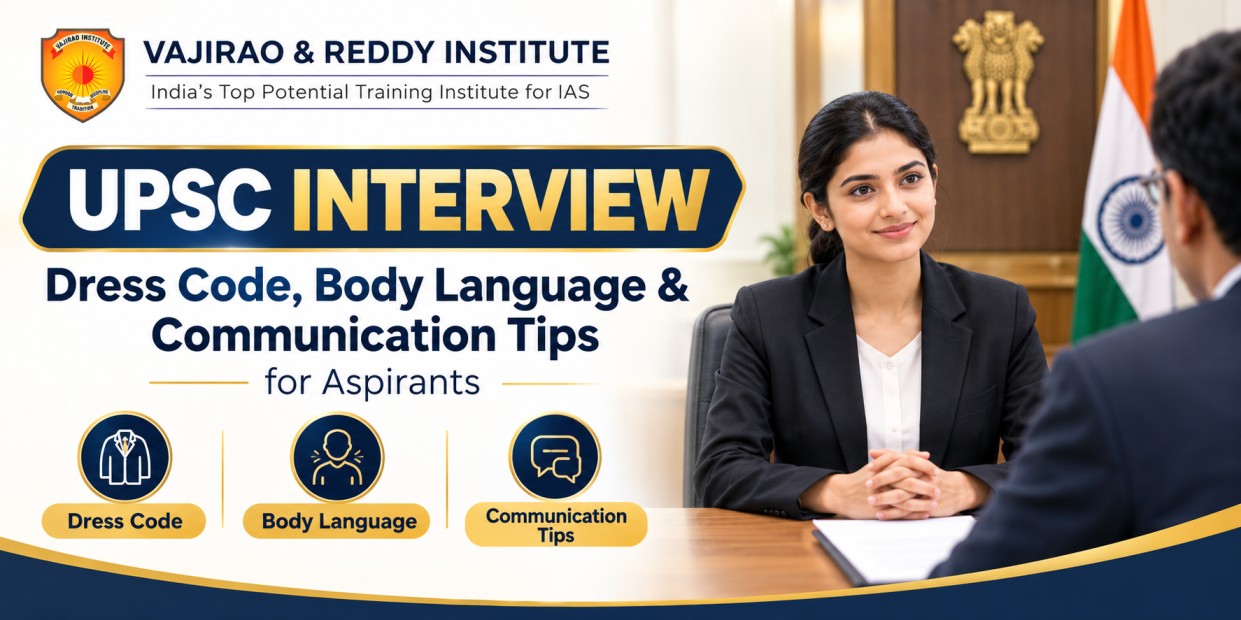
The UPSC Interview, also known as the Personality Test, is the final stage of the Civil Services Examination. It is not only about answering questions related to current affairs, academics, or your optional subject. The interview board also observes your personality, confidence, behaviour, communication skills, and the way you present your thoughts. Your appearance and body language also become a part of your overall presentation. However, there is no need to wear expensive clothes or follow a very strict style. A simple and neat appearance, natural body language, and clear communication are enough. Aspirants should focus on looking comfortable and confident rather than trying to create a different personality during the interview.
UPSC Interview Dress Code for Aspirants
There is no compulsory dress code or fixed uniform for the UPSC Personality Test. Candidates can choose formal and comfortable clothes according to their preference. The main purpose of the dress is to maintain a neat and professional appearance. The clothes should be clean, properly ironed and comfortable enough to sit in for a long time. Avoid clothes that are too bright, heavily designed or uncomfortable. Your dress should allow you to focus on the interview instead of making you conscious about your appearance.
Dress Code for Male Candidates
Male candidates can choose simple formal clothes for the interview. A formal shirt with trousers is a common choice. A blazer or formal suit can also be worn, especially during the winter season.
- Wear a clean and properly ironed formal shirt.
- Choose formal trousers in simple colours.
- Wear clean and comfortable formal shoes.
- Keep your hair neat and properly groomed.
- Avoid very bright colours and flashy patterns.
- Keep accessories simple.
- Use a simple and professional-looking watch if required.
The main focus should be on cleanliness and comfort. Candidates do not need to spend a lot of money on their interview clothes.
Dress Code for Female Candidates
Female candidates can choose a simple saree, salwar suit, or other formal Indian wear. They can also choose formal Western wear if they are comfortable with it.
- Choose simple and comfortable clothes.
- Prefer sober colours and simple designs.
- Wear clean and comfortable footwear.
- Keep jewellery simple.
- Avoid heavy makeup or accessories.
- Keep your hair neat and well-groomed.
- Make sure the clothes are comfortable while sitting.
The best choice is the outfit in which you feel confident and comfortable. The interview is about your personality and not about expensive or fashionable clothing.
UPSC Interview Body Language Tips
Body language plays an important role in face-to-face communication. During the UPSC Interview, the board observes how a candidate enters the room, sits, listens, and responds to questions. UPSC Interview Body Language Tips include maintaining a comfortable posture, appropriate eye contact, attentive listening, and natural facial expressions. Small details can influence how your overall personality is presented. Good body language does not mean sitting stiffly or trying to appear overly confident. It should look natural, calm, attentive, and respectful throughout the interview..
Maintain a Proper Sitting Posture
Your sitting posture should show that you are attentive and comfortable. Sit straight with your shoulders relaxed. Avoid bending too much towards the table or leaning too far back in the chair.
- Keep your back reasonably straight.
- Keep your shoulders relaxed.
- Keep your hands in a comfortable position.
- Avoid constantly changing your sitting position.
- Do not cross your arms while answering.
A relaxed posture can help you remain comfortable during the interview and can also make your communication look more natural.
Maintain Natural Eye Contact
Eye contact shows that you are paying attention to the person speaking to you. When a member of the board asks a question, look at that member while listening and answering. Do not stare continuously at one person. If the answer is longer or involves the whole panel, you can naturally look at other members as well. At the same time, avoid looking at the floor, ceiling, or outside the room while answering.
Keep Your Facial Expressions Natural
Your facial expressions should remain natural during the interview. You do not need to keep a serious face throughout the conversation. A small smile when appropriate is fine. However, avoid laughing unnecessarily or showing frustration when you are asked a difficult question. Your expressions should show that you are calm and comfortable with the discussion.
Avoid Unnecessary Hand and Body Movements
Nervousness can sometimes lead to repeated movements without the candidate realising it. Such movements can distract the board from the answer. Avoid:-
- Tapping your fingers on the table.
- Moving your legs repeatedly.
- Playing with a pen.
- Adjusting your clothes again and again.
- Touching your hair repeatedly.
- Using too many hand gestures.
Normal hand movements while speaking are fine. The focus should be on keeping your movements natural.
Communication Tips for UPSC Interview
Effective communication is an important part of the UPSC Personality Test. The interview board is interested in understanding how a candidate thinks, analyses an issue and expresses their views. You do not need to use complicated English or impressive vocabulary to communicate effectively. Your language should be simple, clear, precise and relevant to the question. Candidates should also listen carefully, understand what is being asked and respond accordingly.
Listen to the Question Carefully
Many candidates become nervous during the UPSC interview and start preparing their response before the interviewer has finished asking the question. This can result in an incomplete or irrelevant answer. Listen to the entire question before responding and take a few seconds to organise your thoughts when necessary. If you are unable to understand the question, politely ask the interviewer to repeat or clarify it rather than making assumptions.
Keep Your Answers Clear and Relevant
A good response does not always have to be lengthy. Give a brief answer when the question requires a direct response and provide an explanation when the question demands reasoning. Keep your answer focused on what has been asked and support your point with relevant facts, examples or reasoning where appropriate. Avoid adding unrelated information simply to demonstrate your knowledge.
Speak at a Comfortable and Natural Pace
Nervousness can cause candidates to speak too quickly, which may affect clarity and confidence. Maintain a natural pace and pronounce your words clearly. Use short pauses between important points so that your response remains organised. Taking a brief pause before answering a difficult or unexpected question is perfectly acceptable and can help you collect your thoughts.
Do Not Try to Show Off Your Knowledge
The UPSC Interview is not a test of how many difficult words you can use or how much information you can include in one answer. Unnecessary use of complex vocabulary can make your communication less effective. Use language that feels natural to you and focus on explaining your thoughts clearly. The board is more interested in your understanding, awareness, reasoning and balanced approach than in sophisticated vocabulary.
Be Honest When You Do Not Know an Answer
No candidate is expected to know the answer to every question. If the board asks something you genuinely do not know, it is better to acknowledge it honestly rather than guess or provide incorrect information. You can politely state that you are not aware of the answer. An honest response demonstrates self-awareness, maturity and the ability to recognise the limits of your knowledge.
How to Handle Difficult Questions?
The interview board may ask unexpected questions, present a challenging situation or ask you to defend or reconsider your opinion. Such questions may assess more than factual knowledge. They can help the board understand your temperament, reasoning ability, openness to different viewpoints and response under pressure. Listen carefully to the complete question before responding and avoid becoming defensive. If you disagree with an opinion or proposition, express your disagreement respectfully and explain the reasoning behind your position. A balanced response is generally more effective than an emotional or confrontational one.
Stay Calm Under Pressure
The panel may ask several questions quickly or move from one topic to another. Remain composed and do not allow one difficult question to affect the rest of your interview. Take a moment to understand each question before responding. Even when you are uncertain or uncomfortable, maintain a respectful tone and answer to the best of your ability.
Accept Different Opinions
During the UPSC Personality Test, you may be asked about social, economic, political, administrative or contemporary issues where multiple viewpoints exist. Present your own opinion confidently, but remain open to alternative perspectives. Instead of trying to prove that your opinion is the only correct one, explain your reasoning and acknowledge valid points on the other side when appropriate. This demonstrates balanced thinking, maturity, and the ability to consider different perspectives.
Common Mistakes to Avoid in the UPSC Interview
Aspirants often focus heavily on preparation and forget the importance of basic presentation. Some simple mistakes can make the candidate appear nervous or less comfortable.
- Wearing clothes that are uncomfortable or too flashy.
- Speaking too quickly.
- Giving very long answers to simple questions.
- Interrupting the interviewer.
- Avoiding eye contact completely.
- Using difficult words unnecessarily.
- Guessing answers when you do not know the facts.
- Becoming defensive when your opinion is questioned.
- Making repeated hand or body movements.
- Trying to copy another candidate’s speaking style or personality.
These things do not mean that one small mistake will decide the result of the interview. The Personality Test is an overall assessment, so candidates should focus on presenting themselves naturally.
What Should Aspirants Keep in Mind?
The most important thing is to remain comfortable with your own personality. Your dress, body language, and communication should support your personality rather than become a source of stress. Choose clothes that you have already worn and feel comfortable in. During communication, focus on listening before answering. Keep your answers simple and honest. If you do not know something, accept it politely. Confidence comes from being comfortable with your preparation and being able to accept that you may not know every answer. The interview board does not expect a candidate to have perfect knowledge of every subject.
Conclusion
The personality test is the final stage of the UPSC interview and is an opportunity for the board to understand the personality behind the written examination. A simple formal dress, good posture, natural eye contact, and clear communication can help you present yourself comfortably. There is no need to create an artificial personality or use complicated language. Listen carefully, answer honestly, remain calm during difficult questions, and respect the views of the interview board. A natural and balanced approach is important throughout the Personality Test.

Vikash is a Current Affairs Expert specialising in UPSC and IAS exam preparation. He simplifies complex national and international developments into clear, exam-oriented insights. His content connects current affairs with the UPSC syllabus and focuses on analysis, facts, and answer writing to help aspirants prepare effectively for the Civil Services Examination.