
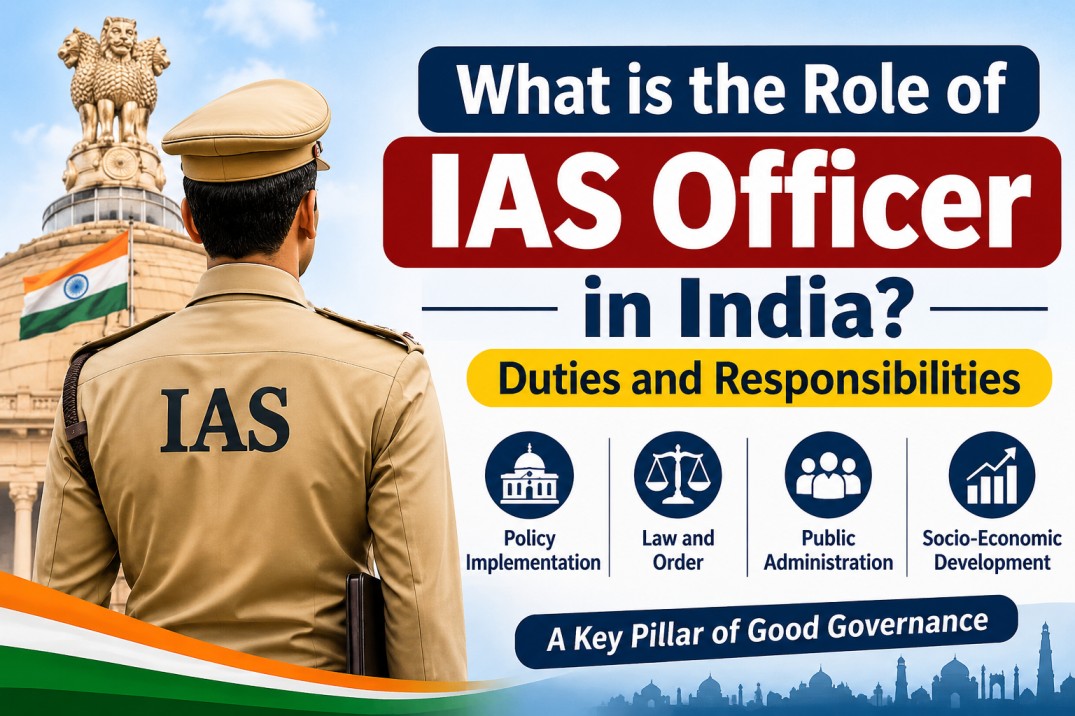
An IAS officer in India plays a crucial role in maintaining effective governance and public administration. Selected through the UPSC Civil Services Examination, IAS officers are responsible for implementing government policies, maintaining law and order, managing administrative affairs, supervising welfare schemes, and promoting socio-economic development. They serve at district, state, and central levels, ensuring that government programmes reach citizens and public services are delivered efficiently. Many people want to become an IAS officer, as they aspire to work for the nation. However, being an IAS officer is not just about securing a prestigious position in the Indian Government. It carries a profound responsibility towards the citizens of India and the system. It is important for a person to understand the implications of being an IAS officer before taking a decision to become one. As a part of his/her job, an IAS officer works at different levels of government, ranging from a district collector to a joint secretary in a central or state government ministry.
Therefore, being an IAS officer offers a plethora of opportunities and responsibilities. It is a fact that being an IAS officer requires handling a lot of work, ranging from running government activities at the ground level to addressing public grievances and overseeing the working of government departments.
What is an IAS Officer?
The Indian Administrative Service (IAS) is one of the three All India services in India. The others are the Indian Police Service (IPS) and the Indian Forest Service (IFS). The recruiting body for all these services is the Union Public Service Commission (UPSC). The major work of an IAS officer is to assist the government administration and oversee the successful implementation of the policies of the government and the schemes of the welfare activities undertaken by it.
Responsibilities of an IAS Officer
IAS officers are given various responsibilities at different levels of government. However, their major responsibility is to manage the administration of the government and to provide efficient services to the citizens. An Indian Administrative Service (IAS) officer is responsible for overseeing public administration, executing government policies, and ensuring effective governance at the district, state, and central levels. The Core Responsibilities is:-
1. Managing District Administration
At the district level, an IAS officer may function as the District Magistrate (DM), Collector or Deputy Commissioner. At this level, an officer is responsible for the overall administration of the district and works in liaison with different government departments. The officers may review the work of different development projects, redress public grievances, and take steps to ensure that government schemes reach the beneficiaries. Officers are involved in relief and rehabilitation works during natural disasters like floods and droughts. Other responsibilities like election-related work may also be assigned to them.
2. Operationalizing Government Policies, Schemes and Programs
To achieve the goals of social and economic transformation, the government formulates various policies and welfare schemes. It is the responsibility of IAS officers to ensure their effective implementation. Aspirants preparing for the civil services examination can also explore the Top 10 Hindi Medium IAS Coaching to understand the available preparation options. IAS officers work with different departments, oversee government programe, and evaluate whether eligible beneficiaries receive the intended benefits. If obstacles arise during the implementation of policies and schemes, officers take necessary steps to resolve them in coordination with the concerned departments. For example, an IAS officer may visit and inspect government schools and hospitals to assess whether the public is receiving proper services from these institutions.
3. Maintaining Administrative Coordination
There are multiple departments within a government administration. Each is responsible for a different developmental goal and works in collaboration to achieve the goal. The duty of IAS officer is to oversee work done by these departments and ensure good coordination. They hold meetings, coordinate with various departments, and examine the work done by them. They discuss issues relating to the administration that hinder the implementation of government policies. For instance, if a development project requires the cooperation of the departments of roads, electricity, water supply, and local administration, an IAS officer is responsible for looking into it and ensuring that work is done properly.
4. Addressing Public Grievances
IAS officers are also responsible for redressing public grievances. People are free to approach the district administration for their grievances relating to land records, public services and entitlements, and other administrative issues. It is the duty of an IAS officer to look into the matter and take action to provide relief, if any, to the applicant. They review departmental work and hold public hearings and review meetings to hear the problems of the public. These activities improve the relations between the government and the public.
5. Relief and Rehabilitation Work
When relief and rehabilitation activities are to be undertaken for victims of a calamity, IAS officers are responsible for organizing and coordinating the work of various government agencies for provision of relief to the victims. For instance, an IAS officer is responsible for looking into all relief and rehabilitation activities in connection with flood and drought relief operations and arranging the supplies required for the purpose.
6. Contributing to Policy Decisions
With experience, IAS officers have the opportunity to work in state and central government ministries. At this level, they are responsible for preparing reports, reviewing policies, advising the government, and supervising officials of various departments. As they have administrative experience at the district level, they know the problems the people face and the problems in the implementation of various policies and programmes of the government. So they are in a better position to suggest changes to the policies and participate in the decision-making process.
What are the Different Positions Held by an IAS Officer?
An IAS officer works at different levels of the government during their career. Their responsibilities are decided by their experience and the requirements of the government. Some important positions held by an IAS officer are:
1. Sub-Divisional Magistrate (SDM)
After their training, an IAS officer may take up the position of Sub-Divisional Magistrate. As an SDM, an officer looks after the administration of a subdivision and supervises various activities of the administration in the subdivision.
2. District Magistrate (DM) or District Collector
With experience, an IAS officer may be appointed as a District Magistrate or District Collector. The officer is responsible for managing important administrative activities in the district. Their work includes coordinating with different departments, reviewing development programmes, addressing public concerns, and managing disaster relief activities. They also play an important role in ensuring the smooth functioning of district administration.
3. Divisional Commissioner
An IAS officer may also be appointed as a Divisional Commissioner. At this level, the officer supervises the administration of several districts within a division. They coordinate with District Magistrates and other senior officials and review the progress of government programmes and development activities. They also look into important administrative matters related to the division.
4. Secretary and Principal Secretary
At the state level, experienced IAS officers may work as Secretaries or Principal Secretaries in different government departments. Their responsibilities include managing departmental activities, preparing policies, coordinating with other departments and advising the government on administrative matters. They also review the implementation of government decisions.
5. Chief Secretary
The Chief Secretary is generally the senior-most administrative officer in a state. The officer coordinates the work of different government departments and advises the state government on important administrative matters.
6. Cabinet Secretary
The Cabinet Secretary is the senior-most civil servant in the Government of India and heads the Cabinet Secretariat. The officer is responsible for coordinating the work of different central ministries and departments and ensuring effective communication within the Union Government.
What is the Career Scope of an IAS Officer?
The Indian Administrative Service offers several career opportunities in different areas of government administration. To understand the impact and achievements of distinguished civil servants, aspirants can also explore the Top 10 Famous IAS Officers in India and learn about their contributions to public service. IAS officers do not work in only one department throughout their careers. They may get opportunities to work in district administration, state government departments, and central ministries. With experience, they can move towards senior administrative positions and become involved in important policy decisions. They may also work in different sectors such as education, healthcare, agriculture, infrastructure, and rural development. IAS officers may also get opportunities to work on deputation in central government organisations, public sector undertakings, and other institutions, as per the applicable rules. The service provides opportunities to take up different responsibilities and gain experience in various fields of administration.
What Skills are Required to Become a Successful IAS Officer?
An IAS officer has to deal with different administrative responsibilities and public concerns. Therefore, along with knowledge and experience, certain skills are important for performing these duties effectively. Some important skills required by an IAS officer include:
- Leadership Skills: An IAS officer should be able to lead teams, coordinate with government officials, and take responsibility for administrative work.
- Decision-Making Skills: Officers often face challenging situations where they need to make important decisions after considering different aspects of an issue.
- Communication Skills: Good communication is important for interacting with citizens, government officials, and other authorities.
- Problem-Solving Skills: An IAS officer should be able to understand problems and find suitable solutions to administrative challenges.
- Time Management: Officers have to manage different responsibilities and complete important tasks within the given time.
- Honesty and Accountability: An IAS officer should perform duties with honesty and remain accountable for administrative decisions.
Conclusion
The Indian Administrative Service offers an opportunity to work in different areas of government administration and contribute to the development of the country. From managing district administration to working in state and central ministries, IAS officers have several responsibilities throughout their careers. For aspirants preparing through UPSC Coaching in Delhi, understanding the roles and responsibilities of an IAS officer is important before choosing this service as a career. The aim should not be limited to clearing the examination or securing a prestigious position. It should also be about understanding an officer’s responsibilities and developing the ability to serve the people with honesty, dedication, and commitment.

Vikash is a Current Affairs Expert specialising in UPSC and IAS exam preparation. He simplifies complex national and international developments into clear, exam-oriented insights. His content connects current affairs with the UPSC syllabus and focuses on analysis, facts, and answer writing to help aspirants prepare effectively for the Civil Services Examination.