
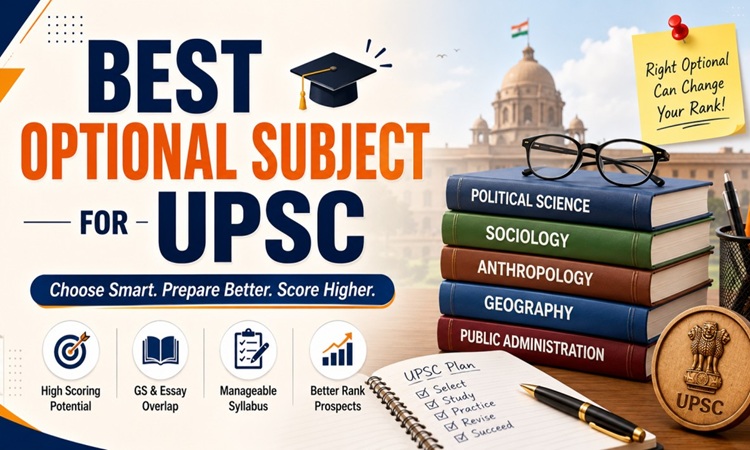
Selecting the best optional subject for UPSC in 2026 is one of the most important decisions in your Civil Services Examination journey. Although the General Studies papers are common for all candidates, the optional subject can significantly influence your final rank. Since the optional papers carry 500 marks in the UPSC Mains Examination, choosing the right subject can provide a competitive edge and improve your chances of securing a top rank. However, there is no single optional subject that is universally considered the best. The ideal optional depends on your academic background, personal interests, aptitude, writing skills, and the time you can dedicate to preparation Many aspirants also seek guidance from a top IAS coaching in Delhi to better understand the syllabus, evaluate optional subjects, and receive expert mentorship that supports informed decision-making throughout their UPSC preparation.
Why is the Optional Subject Important in UPSC?
The optional subject plays a decisive role in determining your final merit position. While General Studies scores are often closely clustered, optional subject marks can vary significantly between candidates. A well-prepared optional subject can compensate for average performance in other papers and improve your overall score in the UPSC Mains Examination. Preparing an optional subject also helps develop analytical thinking, conceptual clarity, and answer-writing skills. Many UPSC Optional Subjects overlap with General Studies and the Essay paper, allowing aspirants to optimize their preparation and reduce the overall study burden.
Factors to Consider Before Choosing an Optional Subject
Choosing an optional subject should be a strategic decision rather than an emotional one. Before making your choice, carefully evaluate your interest in the subject, academic background, syllabus, availability of study material, guidance, and previous years’ question papers. Since the optional subject carries 500 marks in the UPSC Mains examination, selecting the right one can have a significant impact on your final rank. A subject that genuinely interests you will keep you motivated throughout the long preparation journey. If your graduation subject is available as an optional and you have a strong foundation in it, it may reduce preparation time. Similarly, subjects that overlap with General Studies can improve efficiency by allowing you to prepare multiple papers simultaneously. Some optional subjects have concise and relatively static syllabi, while others require continuous integration of current affairs and extensive reading.
Top Optional Subjects for UPSC in 2026
The best optional subject for UPSC in 2026 is not the same for every aspirant. It should align with your academic background, interests, aptitude, and preparation strategy. While there is no universally “best” optional, subjects such as Political Science & International Relations (PSIR), Sociology, Anthropology, and Geography continue to be among the most preferred choices due to their overlap with the General Studies syllabus, relevance to the Essay paper, and well-defined syllabi. Selecting an optional that matches your strengths and offers ample scope for answer writing can significantly enhance your performance in the UPSC Mains Examination. The top optional subjects for the UPSC 2026 exam break down as follows:-
Political Science & International Relations (PSIR)
Political Science and International Relations remains one of the most popular optional subjects among UPSC aspirants. It has substantial overlap with General Studies Paper II, International Relations, Governance, the Essay paper, and even the Personality Test. Aspirants interested in politics, constitutions, public policy, and global affairs often find PSIR both engaging and rewarding. Although the syllabus is extensive, its relevance to current affairs enables candidates to enrich their answers with contemporary examples, making it a strong scoring optional for analytical writers.
Sociology
Sociology is widely preferred because of its concise syllabus and easy-to-understand concepts. The subject examines society, social institutions, culture, and human behavior, making it highly relevant to various General Studies topics. It also complements essay writing and helps aspirants develop a broader understanding of social issues affecting governance and policymaking. Candidates who enjoy connecting theoretical concepts with real-life examples often perform well in Sociology.
Anthropology
Anthropology has gained immense popularity over the past decade due to its relatively short syllabus, scientific approach, and scoring potential. It appeals to candidates from engineering, medical, and science backgrounds while remaining accessible to humanities students. The subject combines conceptual learning with diagrams and case studies, making answers more structured and visually appealing. However, success requires conceptual clarity and regular answer-writing practice.
Geography
Geography continues to be a preferred optional because of its overlap with both the Preliminary Examination and General Studies Paper I. The subject combines physical geography, human geography, environmental studies, and map-based learning. UPSC candidates who enjoy diagrams, maps, and analytical thinking often find Geography Optional an interesting and rewarding subject. However, the syllabus is comparatively vast and demands consistent revision.
Public Administration
Public Administration focuses on governance, administration, organizational theories, and public policy. It shares considerable overlap with General Studies Paper II and topics related to governance and public administration. The subject is particularly suitable for aspirants interested in administrative systems and policymaking. Strong analytical skills and the ability to relate theoretical concepts to current governance issues are essential for scoring well.
Philosophy
Philosophy is known for having one of the shortest optional syllabi in UPSC. It emphasizes logical reasoning, ethics, and philosophical thought rather than memorization. Candidates who enjoy conceptual discussions and analytical writing often perform well in Philosophy. Its Ethics component also proves beneficial for General Studies Paper IV.
History
History remains a popular choice among aspirants with a strong interest in India’s historical evolution and world civilizations. The History optional for UPSC offers considerable overlap with General Studies, particularly Ancient, Medieval, Modern Indian History, and World History. Although the syllabus is extensive, systematic preparation and multiple rounds of revision make it a reliable optional for candidates who enjoy reading historical narratives and analyzing historical developments.
How to Choose the Best Optional Subject for UPSC 2026
Begin by downloading the official UPSC syllabus for all optional subjects and comparing them with your interests and academic background. Carefully review the previous ten years’ question papers to understand the depth and pattern of questions. Reading a few introductory chapters from standard books can help you determine whether you genuinely enjoy studying the subject. You should also evaluate the availability of quality study material, mentorship, answer-writing support, and test series before making your final decision. Once the subject is selected, avoid switching midway through your preparation, as frequent changes consume valuable time and affect consistency.
Common Mistakes to Avoid
Many aspirants make the mistake of selecting an optional solely because it is considered “high scoring” or because successful candidates recommended it. Every aspirant has different strengths, interests, and writing styles, making such comparisons misleading. Another common mistake is delaying the decision for several months. Prolonged indecision reduces the time available for mastering the subject, completing the NCERT books, and practicing answer writing effectively. Aspirants should also avoid neglecting previous years’ question papers and mock tests, as these are essential for understanding the exam pattern, refining answer-writing skills, and meeting UPSC’s expectations.
Is there a Highest Scoring Optional Subject?
There is no officially recognized highest-scoring optional subject in UPSC. Every year, candidates from diverse optional subjects secure top ranks. High scores are determined by conceptual understanding, answer presentation, regular practice, and consistency rather than the subject itself. Instead of searching for the easiest or most scoring optional, focus on selecting a subject that aligns with your strengths and allows you to sustain long-term preparation with confidence.
Conclusion
The best optional subject for UPSC in 2026 is the one that matches your interests, aptitude, educational background, and preparation strategy. A carefully chosen optional can significantly enhance your Mains performance and improve your overall rank. Many aspirants also compare the Best IAS coaching in Delhi to find experienced mentors, quality study material, and optional subject guidance that can help them make an informed choice. Whether you choose Political Science, Sociology, Anthropology, Geography, Public Administration, Philosophy, History, or any other optional subject, success ultimately depends on disciplined preparation, consistent answer-writing practice, regular revision, and a clear understanding of the syllabus. With the right optional and a focused preparation strategy, you can strengthen your chances of achieving success in the UPSC Civil Services Examination 2026.
