
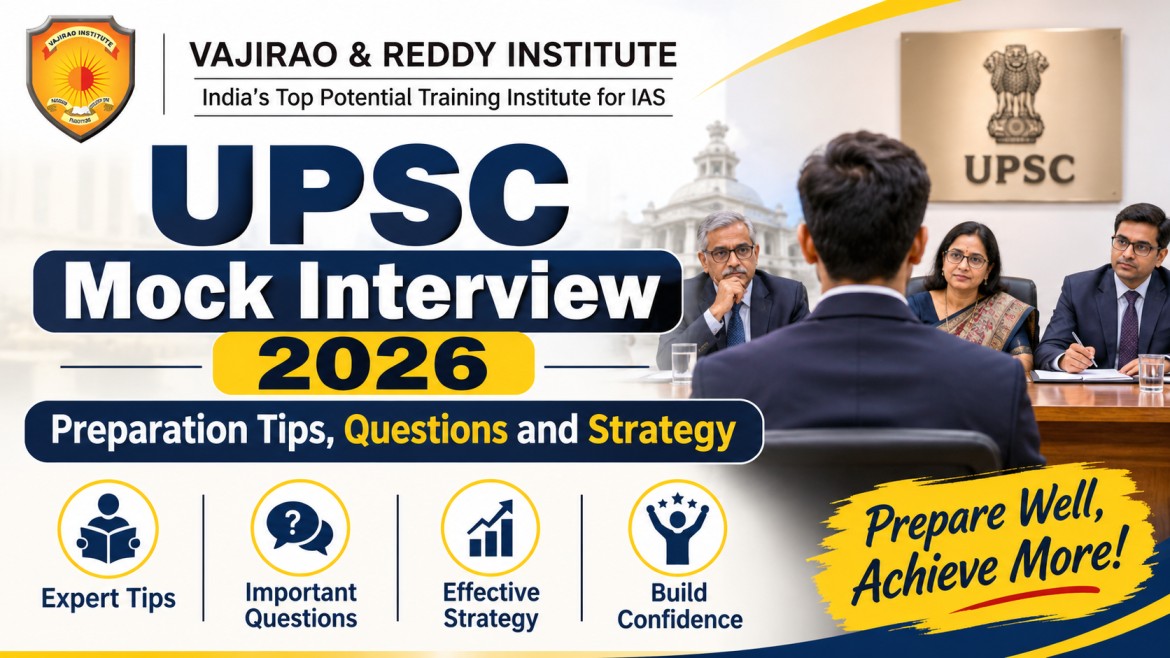
The UPSC Civil Services Personality Test is the final stage of the Civil Services Examination and plays an important role in determining a candidate’s final rank. After clearing the UPSC Mains Examination, candidates must prepare for an interview that evaluates much more than their academic knowledge. Confidence, communication skills, balanced opinions, decision-making ability, awareness of current affairs, and suitability for a career in public service are among the qualities assessed during this stage.
This is where a UPSC Mock Interview becomes particularly useful. It gives aspirants an opportunity to experience a simulated interview environment, interact with an experienced panel, practice answering questions, and identify areas that need improvement before appearing before the actual UPSC interview board. For candidates preparing for the UPSC Interview 2026, starting mock interview practice at the right time can help reduce nervousness and improve their overall presentation. A structured approach involving DAF analysis, current affairs preparation, mock interview sessions and constructive feedback can make the preparation process more effective.
In this blog, we will discuss the importance of UPSC mock interviews, preparation tips, frequently asked questions, common mistakes and effective strategies to perform confidently in the UPSC Personality Test.
What is UPSC Mock Interview?
A UPSC Mock Interview is a simulated version of the actual UPSC Civil Services Personality Test. It is conducted by experienced faculty members, subject experts or interview panels to help candidates understand the interview environment and prepare for different types of questions. During a mock interview, candidates are generally asked questions based on their Detailed Application Form (DAF), educational background, hometown, hobbies, optional subject, current affairs and opinions on important national and international issues. The purpose is not simply to test how much a candidate knows. It is also to evaluate how effectively they communicate their thoughts, respond to unfamiliar questions, handle pressure and present balanced opinions. Unlike a written examination, where answers are evaluated on paper, the UPSC Personality Test involves direct interaction with an interview board. Therefore, practicing in a similar environment can help candidates become more comfortable with the process.
Why UPSC Mock Interview Important?
Preparing for the UPSC Personality Test requires a different approach from Prelims and Mains preparation. Candidates must learn how to express their knowledge naturally, maintain composure and respond thoughtfully to unexpected questions. Here are some important benefits of participating in a UPSC mock interview.
1. Helps Build Confidence
Many candidates feel nervous when facing an interview panel, especially during their first formal interview experience. A mock interview provides an opportunity to practise answering questions in front of multiple people. Repeated practice can help reduce hesitation, improve confidence and make candidates more comfortable with the interview environment.
2. Improves Communication Skills
Knowing the answer and communicating it effectively are two different things. Candidates should be able to explain their thoughts clearly, logically and concisely. UPSC Mock interviews help aspirants practice structured responses, maintain an appropriate speaking pace and avoid unnecessary explanations.
3. Identifies Strengths and Weaknesses
One of the biggest advantages of a mock interview is receiving feedback from an experienced panel. Candidates can understand whether they:
- Give clear and relevant answers.
- Maintain appropriate eye contact.
- Display confidence and composure.
- Present balanced opinions.
- Handle difficult or unexpected questions.
- Communicate effectively through verbal and non-verbal expressions.
This feedback helps aspirants identify areas that require further improvement.
4. Helps With DAF-Based Preparation
The Detailed Application Form (DAF) is an important source of questions during the UPSC Personality Test. Aspirants may be asked about their hometown, educational qualifications, hobbies, work experience, achievements and optional subjects. Mock interviews help candidates identify possible questions from their DAF and prepare meaningful responses based on their personal backgrounds.
5. Develops the Ability to Handle Unexpected Questions
The UPSC interview board may ask questions that candidates have never encountered before. Mock interviews help aspirants practise responding calmly when they do not know an answer. Instead of guessing or becoming nervous, candidates learn to acknowledge their limitations and respond honestly.
How to Prepare for UPSC Mock Interview 2026?
A successful mock interview requires preparation beyond memorising frequently asked questions. Candidates should focus on developing awareness, clarity of thought and the ability to express independent opinions. Here are some practical preparation strategies for the UPSC Mock Interview 2026.
1. Analyse Your Detailed Application Form (DAF)
Your DAF should be the starting point of your interview preparation. Read every section carefully and identify topics from which the interview board may ask questions. Pay particular attention to:
- Your name and its meaning.
- Hometown, district and state.
- Graduation subject and academic background.
- Optional subject.
- Hobbies and extracurricular activities.
- Previous employment or professional experience.
- Achievements and personal interests.
For example, if you have mentioned reading as a hobby, prepare to discuss your favorite books, authors and recent reading experiences. Similarly, candidates belonging to a particular district should understand its history, economy, culture, important institutions and major development challenges. Do not prepare artificial or memorized answers. Focus on understanding the information you have mentioned in your application form.
2. Stay Updated With Current Affairs
Current affairs play an important role in UPSC interview preparation. Candidates should remain aware of important national and international developments. Focus on the following areas:-
- Indian economy and economic policies.
- Government schemes and initiatives.
- India’s foreign relations.
- International organizations and global developments.
- Science and technology.
- Environmental challenges and climate change.
- Social issues and governance.
- Important Supreme Court judgments.
- Recent developments in your home state.
While reading the newspaper, try to understand different perspectives on an issue. Develop your own balanced opinion rather than simply memorising facts.
3. Revise Your Graduation and Optional Subjects
The interview board may ask questions related to your graduation subjects and optional paper. Therefore, candidates should revise important concepts, basic terminology and recent developments connected with their academic backgrounds. For example, an engineering graduate may be asked about the practical applications of technology in public administration, while an economics graduate may face questions about inflation, unemployment, fiscal policy or economic growth. You do not need to revise every topic in exhaustive detail. Focus on fundamentals and understand how your academic knowledge can be connected with contemporary issues.
4. Prepare Your Home State and District
Questions about a candidate’s hometown and home state are common areas of UPSC interview preparation. Prepare information about:
- Historical background and cultural heritage.
- Geography and natural resources.
- Major industries and economic activities.
- Agriculture and important crops.
- Tourism and important historical places.
- Social development indicators.
- Major governance challenges.
- Recent state government initiatives.
Candidates should also understand the problems faced by their local communities and think about practical solutions from an administrative perspective.
5. Practice Answering Questions Aloud
Reading interview questions silently is not enough. Candidates must practice speaking their answers. Choose a topic, frame your response and explain your viewpoint aloud. You can also record yourself to evaluate your speaking speed, clarity, confidence and body language. Try to keep your answers relevant and concise. Avoid giving unnecessarily long explanations or using complicated terminology when simple language can communicate the same idea.
6. Work on Body Language and Presentation
Non-verbal communication also contributes to the overall impression you create during an interview. Keep the following points in mind:
- Maintain natural eye contact with the panel.
- Sit comfortably with an attentive posture.
- Avoid unnecessary hand movements.
- Listen carefully before answering.
- Maintain a calm facial expression.
- Speak clearly and at a comfortable pace.
- Wear clean, formal and comfortable clothing.
Remember that confidence does not mean being overly expressive or aggressive. A calm, respectful and natural approach is more effective.
Important UPSC Mock Interview Questions for 2026
Although there is no fixed list of questions for the UPSC Personality Test, candidates can practice different categories of questions to improve their preparation. Here are some examples of questions that aspirants can use during their mock interview practice.
1. Personal and DAF-Based Questions
- Tell us something about yourself.
- What motivated you to choose the Civil Services?
- Why do you want to become an IAS officer?
- What are your biggest strengths and weaknesses?
- How has your educational background prepared you for public service?
- What are your hobbies, and what have you learned from them?
- Why should the administration select you for a leadership role?
2. Current Affairs and General Awareness Questions
- What are the major challenges facing the Indian economy today?
- How can India improve its position in global manufacturing?
- What are the opportunities and challenges associated with Artificial Intelligence?
- How can India balance economic development with environmental protection?
- What are the major challenges facing India’s urban governance?
- How can India strengthen its international relations?
- What role can technology play in improving public service delivery?
3. Situational and Administrative Questions
- What would you do if a senior officer asked you to take an action against established rules?
- How would you handle a situation involving communal tension in your district?
- What steps would you take if government welfare benefits were not reaching eligible beneficiaries?
- How would you respond to a natural disaster in your district?
- What would you do if you discovered corruption in a government department?
- How would you balance political pressure with administrative responsibility?
- How would you resolve a conflict between two communities over a public resource?
4. Home State and District-Based Questions
- What are the major development challenges in your district?
- Which industries have the potential to generate employment in your state?
- What steps can improve the education system in your hometown?
- What are the major environmental concerns in your region?
- How can tourism contribute to your state’s economy?
These questions are examples for practice, not predictions of actual UPSC interview questions. Candidates should prepare based on their own DAF and the latest developments.
Common Mistakes to Avoid During a UPSC Mock Interview
Participating in a mock interview is useful only when candidates learn from their mistakes. Repeating the same mistakes without analyzing feedback can reduce the effectiveness of practice sessions. Avoid the following common mistakes:
1. Memorizing Answers
The UPSC Personality Test is an interactive assessment. Memorized responses may sound unnatural and make it difficult to handle follow-up questions. Focus on understanding concepts and expressing your thoughts naturally.
2. Giving Overconfident Answers
Candidates should not pretend to know everything. If you are unfamiliar with a question, it is better to acknowledge it politely rather than provide incorrect information.
3. Ignoring DAF Preparation
Some aspirants focus heavily on current affairs but overlook personal information mentioned in their DAF. This can create difficulties when the board asks questions about their hometown, hobbies or educational background.
4. Giving Extremely Long Answers
Avoid unnecessary explanations. Listen carefully, understand the question and respond directly. If the board wants more information, it may ask a follow-up question.
5. Becoming Defensive During Discussions
The interview board may challenge your opinion or present an alternative viewpoint. Do not treat this as an argument. Listen carefully, remain respectful and explain your reasoning logically.
6. Ignoring Feedback After Mock Interviews
Feedback is one of the most valuable parts of a mock interview. Candidates should note the suggestions provided by the panel and work on them before their next session.
How Many UPSC Mock Interviews Should You Attend?
There is no fixed number of mock interviews that every UPSC aspirant must attend. The ideal number depends on your level of preparation, communication skills, confidence and ability to improve through feedback. Instead of participating in too many sessions, focus on the quality of each mock interview. A practical approach can include:
- Begin with an initial mock interview to understand your current level.
- Analyze the feedback and identify areas requiring improvement.
- Work on DAF-based questions and current affairs.
- Participate in another mock interview after making improvements.
- Focus on specific weaknesses rather than repeating the same preparation routine.
The objective should be improvement in clarity, confidence and personality presentation, not collecting a large number of mock interview certificates.
How to Choose the Right UPSC Mock Interview Program?
Selecting an appropriate UPSC/IAS mock interview program is an important part of the final stage of preparation. Before enrolling, consider the following factors:
1. Experienced Interview Panel: Look for a program that provides meaningful interaction with experienced faculty members and subject experts.
2. DAF-Based Preparation: The mock interview should include questions based on your personal background, educational qualifications, hometown, hobbies and optional subject.
3. Realistic Interview Environment: A structured interview setting can help candidates become familiar with the formal environment of the Personality Test.
4. Detailed Feedback: Choose a program that provides constructive feedback on communication, body language, confidence and the quality of responses.
5. Individual Attention: Personalized suggestions can help candidates understand their specific strengths and weaknesses.
6. Current Affairs Coverage: The program should encourage awareness of contemporary national and international developments.
UPSC Mock Interview Preparation With Vajirao & Reddy IAS Institute
Preparing for the UPSC Personality Test requires more than collecting possible questions and memorizing answers. Candidates need proper guidance, regular practice and an opportunity to understand how they perform in an interview environment. At Vajirao & Reddy IAS Institute, aspirants can explore mock interview guidance to prepare for the final stage of the Civil Services Examination. The mock interview preparation process can help candidates focus on:
- DAF-based interview preparation.
- Important national and international current affairs.
- Questions related to academic backgrounds and optional subjects.
- Home state, district and personal interests.
- Communication skills and body language.
- Confidence-building and interview practice.
- Feedback to identify areas for improvement.
Candidates preparing for the UPSC Interview 2026 can visit the UPSC Mock Interview Registration Page to explore the available registration details. The objective is to help aspirants approach the Personality Test with better preparation, clarity of thought and confidence.
Conclusion
The UPSC Personality Test is an opportunity for candidates to demonstrate their awareness, judgement, communication skills and suitability for public service. While knowledge remains important, the ability to express ideas clearly, remain composed under pressure and present balanced opinions also matters. A well-planned UPSC Mock Interview 2026 preparation strategy should include DAF analysis, current affairs revision, academic subject preparation, home state awareness and regular speaking practice. Remember, a mock interview is not about predicting the questions that the actual board will ask. It is about understanding yourself, identifying weaknesses and becoming better prepared to handle different situations.
Stay confident, remain honest in your responses and focus on continuous improvement. With consistent practice and the right guidance, you can approach the UPSC Personality Test with greater confidence.

Vikash is a Current Affairs Expert specialising in UPSC and IAS exam preparation. He simplifies complex national and international developments into clear, exam-oriented insights. His content connects current affairs with the UPSC syllabus and focuses on analysis, facts, and answer writing to help aspirants prepare effectively for the Civil Services Examination.