
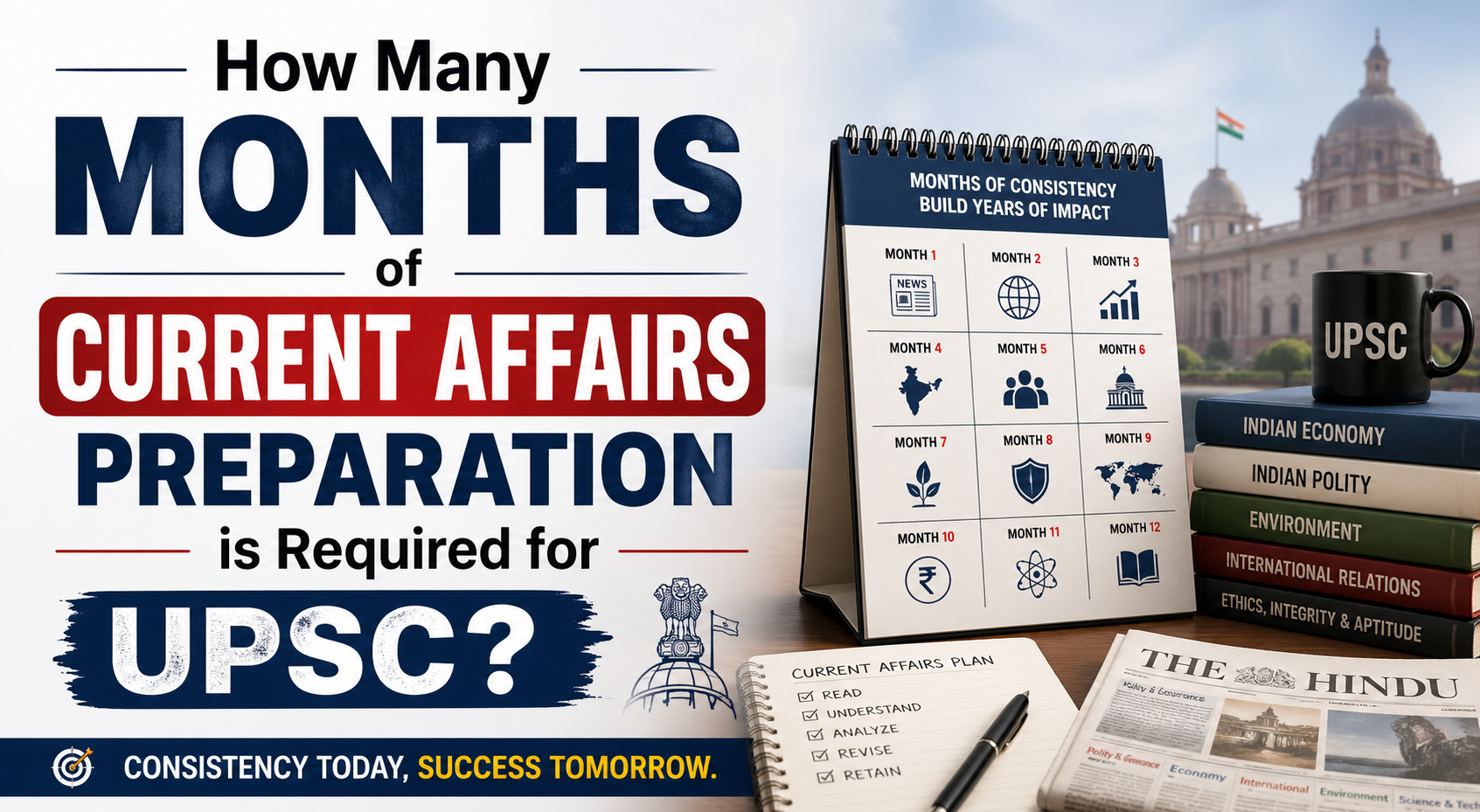
UPSC aspirants should prepare at least 12 to 15 months of current affairs before Prelims. It improves revision, connects dynamic topics with static subjects, and boosts Prelims and Mains readiness. Preparing current affairs is extremely important for success in the UPSC exam. Current affairs helps with enhanced answer writing, improved Prelims accuracy, helps in development of analytical skills, Interview preparation and enriches the mind of aspirants with insights about real world problems. Ideally aspirants should start studying current after 15 months before the tentative Prelims date. This will keep aspirants ready in advance and will help with managing the lengthy UPSC syllabus simultaneously. For the Mains exam, at least 10-12 months of coverage is necessary to understand the context of issues.
To master current affairs, aspirants should limit their sources to avoid information overload and confusion. They should only read news that align with the UPSC syllabus and avoid reading unnecessary crime stories, gossip and entertainment news that doesn’t serve any purpose. Aspirants should link current affairs with static subjects to prepare the GS topics simultaneously, revise regularly and make effective notes. UPSC aspirants can also take current affairs based mock tests to analyse their preparation quality and what areas need improvement. Even aspirants joining Top IAS coaching in Delhi are advised to cover 12–15 months of current affairs, as consistent revision and issue-based preparation remain crucial for UPSC Prelims and Mains success.
What is the Importance of Current Affairs in UPSC Preparation?
For UPSC, studying 12 to 15 months of current affairs before the exam is ideal. This approach aids revision, strengthens conceptual links, and is crucial for success in UPSC Prelims and Mains. Current affairs are very important for UPSC preparation as it helps to link static subjects with real world scenarios, enhances answer writing for Mains, improves Prelims accuracy and helps to develop analytical skills. Let’s take a look at the importance of current affairs in UPSC preparation:-
Integration with Static Subjects
Current affairs help link static subjects to contemporary developments and real world scenarios. For example, a news item on climate change links to environmental studies or a Supreme Court of India judgment connects to constitutional provisions.
Enhanced Answer Writing for Mains
Studying current affairs helps to enrich answers with up to date case studies, data, reports, and examples. This makes the answers impressive and it boosts scoring potential. However, aspirants need to learn how to connect current affairs with the answers.
Improved Prelims Accuracy
Questions in UPSC Prelims are objective and concept based. Studying current affairs helps to tackle difficult questions as many questions are directly or indirectly related to current events, government schemes and policies.
Personality Test Preparation
Studying current affairs provides valuable insights required to crack the UPSC Personality test. UPSC always appreciates potential civil servants who are aware of the ongoing events of the world and can think logically about challenges.
Development of Analytical Skills
Studying current affairs moves aspirants beyond memorization and develops the ability to analyze the news, understanding it’s causes, effects and solutions. This develops analytical skills and also boosts administrative aptitude.
How many Months of Current Affairs Preparation is Required for UPSC?
For the UPSC Civil Services Examination, 12 to 15 months of current affairs is important before the Prelims exam. Generally, 10-12 months of current affairs coverage is important. Let’s understand how many months of current affairs preparation is required for UPSC:-
- The Ideal Range: 12-15 months prior to the Prelims exam date is considered safe.
- Essential Period: In case Prelims is in late May, aspirants should focus on news from January to April.
- Minimum Requirement: At least 10-12 months of coverage is necessary to understand the context of issues, especially for Mains.
Tips to Master Current Affairs for UPSC Preparation
Mastering current affairs for UPSC requires a syllabus centric approach. Aspirants should make effective notes, link current affairs with static subjects and limit their current affairs sources. To master current affairs for UPSC, rely on limited and trusted sources such as one newspaper (The Hindu or Indian Express), one monthly magazine, and PIB for government schemes and policies. Link current events with the static syllabus, prepare concise notes on facts and reports, and focus on regular revision. Let’s take a look at the tips to master current affairs for UPSC preparation:-
Limit your Sources
Aspirants should avoid information overload by sticking to quality sources of current affairs. Newspapers such as The Hindu or Indian Express and government sources such as PIB updates, Yojana and Kurukshetra magazine are reliable options.
Syllabus Centric Approach
Aspirants should only read news aligned with the UPSC syllabus and ignore irrelevant news such as crime stories, gossip and entertainment news. Instead, they should focus on news related to policy changes, economy and environment.
Link with Static Subjects
While studying current affairs, aspirants should connect news to static subjects such as Polity, Economy, Environment and Science. This will help with simultaneous preparation of GS subjects and will boost conceptual clarity.
Effective Note Making
Aspirants should create precise digital or physical notes categorized by topics such as Polity, Economy, Science. They should focus on key takeaways and not just headlines. Effective note making helps aspirants in quick revision.
Regular Revision and Mock Tests
Conclusion
Studying current affairs is very important for success in the UPSC exam. It helps with improved Prelims accuracy, Personality Test preparation, development of analytical skills and enhanced answer writing for Mains exam. Ideally, aspirants should start preparing for current affairs 15- 12 months before the Prelims exam to ensure they don’t skip anything. To master current affairs, aspirants should learn to make effective notes, revise regularly, link news with static subjects, limit their sources and apply a syllabus centric approach. For the 2026–27 UPSC session, leading Top 10 IAS coaching institutes in Delhi include Vajirao and Reddy, known for personalized mentorship, and Vajirao and Reddy Institute, recognized for its legacy and consistent results. Vajirao and Reddy has a strong presence in Shakti Nagar, Delhi.
