
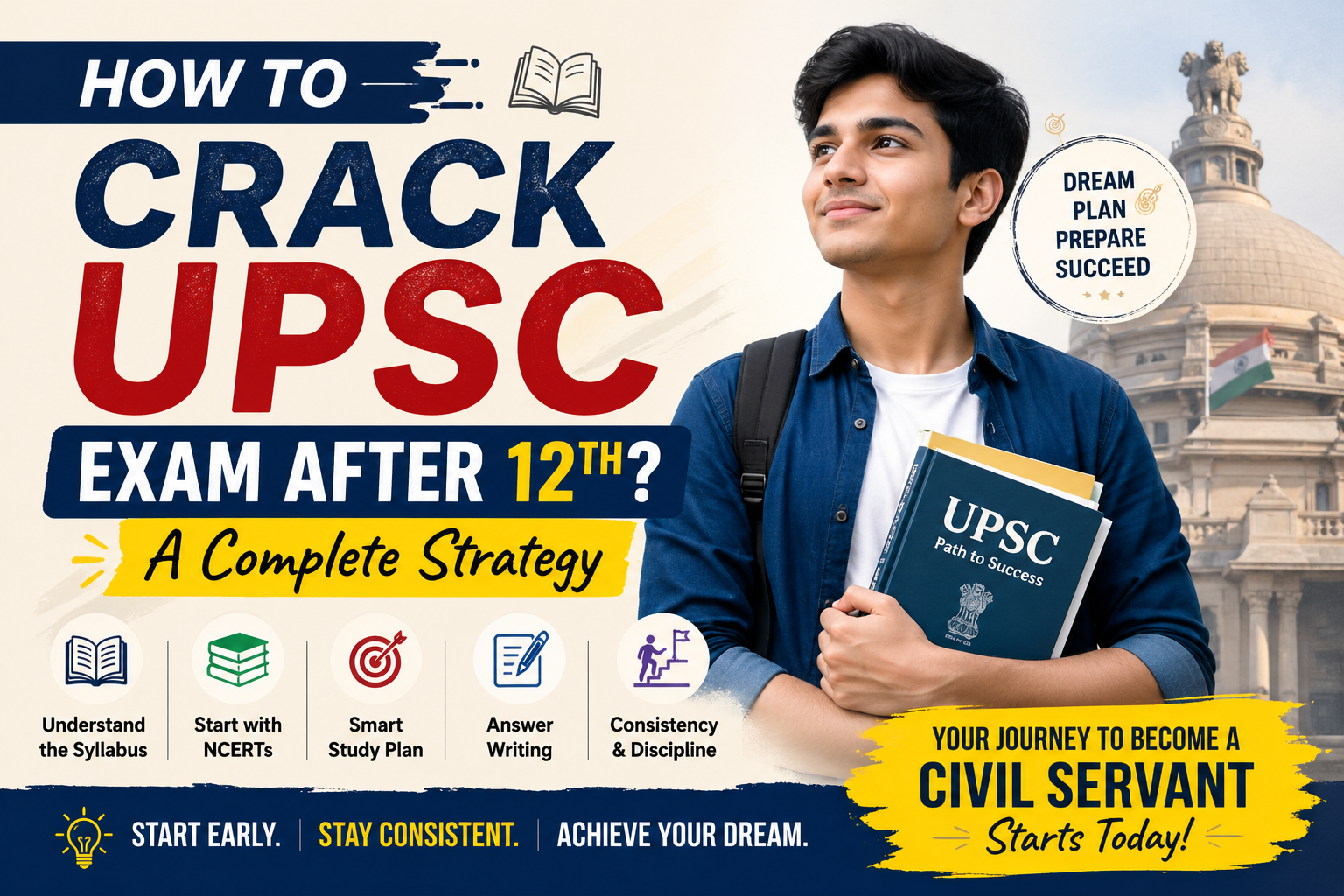
Cracking the IAS (UPSC Civil Services) exam after 12th begins with early preparation during college, since a bachelor’s degree is required to appear for the UPSC exam. Start by building a strong foundation through NCERT books (Classes 6-12), develop a habit of reading newspapers like The Hindu daily, understand the UPSC syllabus thoroughly, and practice answer writing consistently over 2–3 years for effective preparation. Aspirants need to select the right graduation course, the right study materials and the right optional subject. If aspirants are thinking about this journey right after their 12th, they already have a strong advantage over time. To crack the UPSC exam, aspirants should first start with NCERTs as they help build foundational knowledge for the advanced preparation later.
Aspirants should take time to understand the UPSC CSE syllabus to sort relevant and irrelevant subjects. They should then opt for the right graduation course which aligns with the UPSC syllabus such as History, Geography, Economy, Sociology and Political Science. Aspirants should also read quality newspapers daily, read quality standard books and develop important skills such as answer writing, communication skills and administrative aptitude along with their studies. Aspirants should opt a relevant optional subject which aligns with their interests or graduation subjects to enhance scoring potential.
What is UPSC Civil Service Examination?
The UPSC Civil Services Examination (CSE) is one of India’s most prestigious national-level competitive exams, conducted annually by the Union Public Service Commission to recruit officers for elite services such as the Indian Administrative Service (IAS), Indian Police Service (IPS), and Indian Foreign Service (IFS). The UPSC CSE examination is conducted in three stages: UPSC Preliminary Examination (objective), UPSC Main Examination (descriptive), and the UPSC Personality Test (Interview). which is designed to select aspirants for top-level administrative and policy-making positions.
How to Crack UPSC Exam after 12th?
Cracking the UPSC exam after 12th requires a focused 3-4 year strategy that begins alongside graduation. It involves building a strong foundation through NCERT books (Classes 6-12), understanding core subjects early, and developing a consistent habit of reading newspapers such as The Hindu or The Indian Express for current affairs. Aspirants can’t crack the UPSC exam directly after 12th. They first need to finish their graduation in order to be eligible for the UPSC exam. However, aspirants can start preparing for the exam right after 12th.
To crack the UPSC exam, aspirants should start IAS preparation immediately after 12th. The UPSC exam is a three stage examination including the Prelims which is objective in nature, Mains which is a written exam and Interview which serves as a Personality Test. The examinations are conducted in all languages mentioned in the Indian Constitution so aspirants can choose a language of their comfort. Choosing the best IAS coaching in Delhi for UPSC Preparation provides aspirants expert mentorship, structured study plans, quality test series, and the right guidance to begin preparation after 12th.
What is the Eligibility Criteria to Appear for the UPSC Civil Service Examinations?
To appear for the UPSC Civil Services Examination, a candidate must meet key eligibility criteria, including being an Indian citizen (with certain provisions for eligible nationals from Nepal, Bhutan, and specific categories of persons of Indian origin), holding a degree from a recognized university, and being between 21 and 32 years of age as per the prescribed cutoff date. General and EWS candidates are allowed 6 attempts, OBC candidates have 9 attempts, while SC/ST candidates can attempt the exam up to the upper age limit as per applicable rules. Let’s’ take a look at the UPSC CSE Eligibility Criteria Overview to appear for the UPSC civil service examination:-
- Nationality: Aspirants must be citizens of India, Nepal, Bhutan or Tibetan refugees settled before 1 Jan 1962. People of Indian origin who migrated from specific countries can also apply.
- Age Limit: Minimum 21 years and maximum 32 years as of August 1st of the examination year. OBCs aged 21-35 years, SC/ST 21-37 years and PwBD 21-42 years can apply.
- Educational Qualification: A bachelor’s degree from a recognized university. Final year students can apply provisionally.
- Number of Attempts: General category have 6 attempts, OBC have 9 attempts, PwBD have 9 attempts and SC/ST have unlimited attempts.
How to Start UPSC Preparation after 12th?
To start UPSC preparation after 12th, aspirants should understand the syllabus, read the newspaper daily, choose the right graduation degree, choose optional subjects wisely and prefer consistency over intensity. Let’s take a look at how to start UPSC preparation after 12th:-
Understand the UPSC Syllabus for UPSC Preparation
Understanding the UPSC syllabus means viewing it as a roadmap for preparation rather than just a list of topics. It involves studying the official syllabus in detail, breaking broad subjects into micro-topics, linking them with UPSC PYQs Previous Year Questions paper and integrating them with daily current affairs for a more focused preparation strategy.
Start with NCERTs Books for UPSC Preparation
Starting with NCERT books is essential for UPSC preparation, as they help build a strong conceptual foundation through Classes 6–12. Begin with Classes 6–10 to strengthen basic understanding, then move to Classes 11–12 for deeper subject knowledge, with special focus on core areas such as History, Geography, Polity, and Economics.
Read Newspaper Daily for UPSC Preparation
For current affairs preparation, aspirants should make reading a national newspaper a daily habit. Rely on quality newspapers such as The Hindu and The Indian Express, and dedicate at least 45-60 minutes each day to strengthen understanding of current affairs and improve analytical awareness.
Choose the Right Graduation Degree for UPSC Preparation
The best graduation degree for UPSC is one that matches your interests, offers a solid backup career option, and ideally overlaps with core UPSC subjects such as History, Geography, Political Science, or Economics. A Bachelor of Arts (BA) is often considered a popular choice due to its significant overlap with the General Studies syllabus. However, candidates from any recognized degree background can successfully prepare for and clear the UPSC exam. Choosing the Best IAS Coaching in Delhi for UPSC Preparation provides aspirants expert mentorship, structured study plans, quality test series, and the right guidance to begin preparation after 12th.
Core Skills to Develop for UPSC for UPSC Preparation
Developing skills for UPSC preparation requires a disciplined approach that combines analytical thinking, consistent answer writing practice, current affairs integration, and long-term perseverance. Essential skills include critical analysis, mental stamina, time management, and effective note-making, which can be strengthened through NCERT study, daily newspaper analysis, and regular mock test practice.
Read Quality Standard Books for UPSC Preparation
For comprehensive UPSC preparation, experts recommend combining NCERT books for conceptual clarity with standard reference books for deeper understanding. The key strategy is to keep resources limited, rely on high-quality sources, and focus on revising them multiple times instead of consulting too many books. Understanding the Importance of Test Series in IAS Preparation helps aspirants improve answer writing, assess performance, identify weaknesses, and build exam temperament essential to crack UPSC after 12th.
Choose Optional Subject for UPSC Preparation
Choosing the right optional subject for UPSC (500 marks) is a crucial and personal decision that should be based on your interest in the subject, overlap with the General Studies syllabus, and availability of quality resources and guidance. Prioritize a subject you genuinely enjoy, as it helps sustain long-term preparation. Popular optional choices often include Anthropology, Sociology, Geography, and PSIR because of their scoring potential and significant syllabus overlap.
Prefer Consistency over Intensity for UPSC Preparation
For UPSC preparation, consistency through steady daily effort is far more effective than sporadic bursts of intense study. It improves retention, reduces stress, and builds the discipline needed to break the vast syllabus into manageable daily targets. Focusing on sustainable progress, such as 6-8 productive hours a day, is often more beneficial than irregular 14 hour study sessions, as it helps prevent burnout and supports long-term memory essential for UPSC success.
Conclusion
To crack the UPSC exam after 12th, aspirants should begin preparation early, ideally alongside graduation. The first step is choosing a graduation degree that aligns well with the UPSC syllabus and personal interests. Next, they should understand the syllabus in depth to distinguish relevant topics from less important areas. Joining the offline and best IAS online coaching in Delhi for UPSC preparation helps aspirants access expert guidance, flexible learning, quality study material, and test series support from the beginning. Preparation should begin with NCERT books to build a strong conceptual foundation before moving to advanced resources. Alongside academic study, aspirants should also develop essential skills such as answer writing, communication, and administrative aptitude for holistic preparation.
