
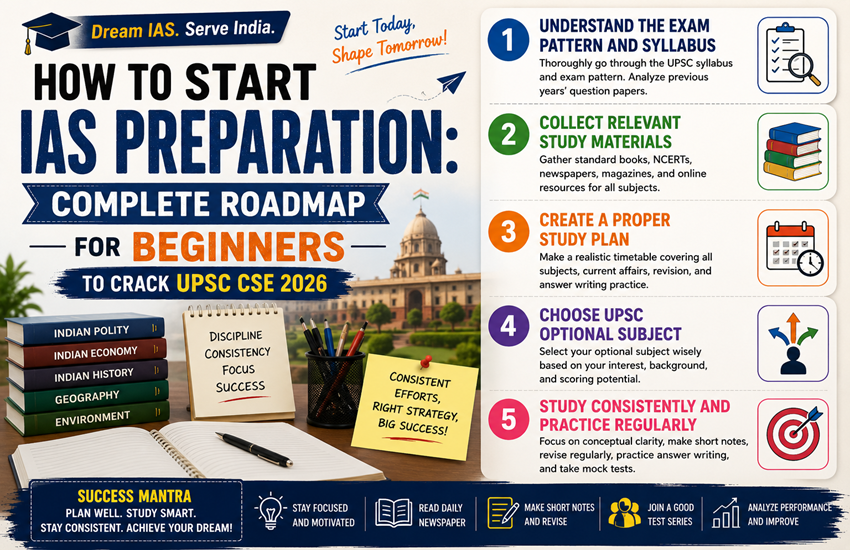
Here learn How to Start IAS Preparation. Preparing for the IAS Exam (UPSC Civil Services Examination) requires a well-planned and systematic approach. Start by thoroughly understanding the official UPSC syllabus and reviewing UPSC previous year question papers (PYQs) to understand the exam pattern and important topics. Build a strong conceptual foundation by studying NCERT textbooks from Classes 6 to 12, and then move on to standard reference books along with regular newspaper reading for current affairs preparation. Many aspirants want to crack the UPSC Civil Services Examination 2026. However, aspirants face confusion with starting the preparation, finding exam-oriented strategies which enhances scoring potential and figuring out the correct study materials for UPSC preparation. This is where Vajirao and Reddy IAS Institute has earned the trust of aspirants because their courses, strategies and study materials have proved to be highly beneficial for many aspirants.
Starting IAS preparation as a beginner requires a smart and systematic strategy. Understanding the UPSC syllabus thoroughly, then build a strong foundation through NCERT books. Develop the habit of reading newspapers daily for current affairs, choose an optional subject wisely, and strengthen your preparation through regular answer writing practice, revision, and mock tests. Vajirao and Reddy Institute believes that building a strong foundation with NCERTs should always be the first step. Aspirants should always start in depth preparation after strong basics, with standard books such as M. Laxmikanth for Polity and GC Leong for Geography. They can also enroll in the institute’s Prelims cum Mains Comprehensive course for mastering the subjects. Simultaneously, aspirants should also practice answer writing to develop the ability to write compelling and scoring essays with the help of the Essay course which is specially designed to help improve format, structure and quality of the answers.
Important Dates of UPSC Civil Service Exam 2026
According to the UPSC Notification 2026, the online registration process for the UPSC Prelims will begin on 14 January 2026, while the last date to submit the application form is 3 February 2026. The UPSC Mains Examination 2026 is scheduled to commence on 21 August 2026. The remaining important dates will be announced later by the commission. Check out the key dates for the UPSC Civil Services Examination 2026 below.
| UPSC Civil Service Exam 2026 Date | |
| Particular | Date |
| UPSC Notification 2026 Release Date | 14 January 2026 |
| Deadline for Submission of UPSC Form | 3 February 2026 |
| UPSC Prelims Admit Card | May 2026 |
| UPSC Prelims Exam Date 2026 | 24 May 2026 |
| Mains Admit Card | Yet to be announced |
| UPSC Mains Exam Date 2026 | 21 August 2026 |
| Registration for DAF-ll Form | Yet to be announced |
| Personality Test | Yet to be announced |
Complete Roadmap of IAS Preparation for UPSC Beginners
A well-structured IAS preparation roadmap for UPSC beginners should follow a phased strategy over 12 to 18 months. Start by understanding the official syllabus and building conceptual clarity through NCERT textbooks. Once the basics are strong, move on to standard reference books, daily current affairs preparation, regular revision, and consistent Mains answer writing practice to strengthen analytical and writing skills. Let’s understand how to start your UPSC preparation from scratch with a detailed step-by-step guide:-
1. Understand the Exam Pattern and UPSC Syllabus
The UPSC Civil Services Examination (CSE) is one of India’s most prestigious and competitive examinations, designed to select candidates for various civil services positions. The selection process comprises three stages: the Preliminary Examination, the Main Examination, and the Personality Test (Interview). Each stage evaluates different aspects of a candidate’s knowledge, analytical ability, decision-making skills, and overall suitability for a career in public service. Before starting IAS preparation, aspirants should understand the UPSC CSE syllabus and Exam pattern to identify important topics. This approach will help aspirants to understand what subjects should be studied on priority.
2. Collect Relevant UPSC Study Materials
Building a strong UPSC preparation strategy begins with selecting the right study materials. Aspirants should focus on essential NCERT textbooks, standard reference books, and reliable current affairs resources that comprehensively cover the UPSC syllabus. Rather than collecting excessive material, it is important to prioritize quality resources that provide conceptual clarity and relevant exam-oriented content. For IAS exam preparation, aspirants are recommended to start with NCERT textbooks to create a strong foundation and then study standard books. They can also utilise Vajirao & Reddy Institute’s Comprehensive study materials which provides GS notes, NCERT notes and current affairs magazines.
3. Create a Proper Study Plan
It is advisable to create a study plan as per individual strengths and weaknesses to avoid confusion with topics. It will help to organise the day better, eliminate distractions and create space for revision. To begin UPSC exam preparation, aspirants should first understand the exam pattern & syllabus, gather relevant study materials, create a proper study plan and choose optional subjects wisely. To begin UPSC preparation, aspirants should first understand the exam pattern and syllabus, gather relevant resources such as their comprehensive study materials and create a proper study plan.
4. Choose UPSC Optional Subject
Choosing the right optional subject for the UPSC Civil Services Examination is one of the most important decisions in an aspirant’s preparation journey. The ideal optional subject varies from candidate to candidate and should be selected based on individual strengths, academic background, interests, and long-term preparation strategy. Aspirants should choose their optional subject for Mains wisely. Because it can drastically boost the scoring potential of aspirants as the subject is chosen based on personal interest. Also, aspirants can enroll in the Vajirao and Reddy Institute Optional Subject Course for better guidance.
Daily Time Table for IAS Preparation
An effective daily UPSC timetable balances early morning current affairs, core subject study slots, optional subject and crucial evening revision sessions. It also incorporates breaks, exercise and dedicated mock tests for performance evaluation. Let’s take a look at the daily time table for IAS preparation.
| Daily Time Table for UPSC Preparation | |
| Time Slot | Activity |
| 6:00 AM to 8:00 AM | Wake Up, Exercise, Newspaper Reading (Current Affairs). |
| 8:00 AM to 8:30 AM | Breakfast Break |
| 8:30 AM to 1:00 PM | Study slot I (Polity, History and Geography) |
| 1:00 PM to 2:00 PM | Lunch Break |
| 2:00 PM to 4:00 PM | Study slot II (Optional Subject) |
| 4:00 PM to 5 PM | Study slot lll (Economy and Science) |
| 5:00 PM to 6:00 PM | Break |
| 6:00 PM to 7:00PM | Study slot IV (CSAT) |
| 7:00 PM to 8:30 PM | Study slot V (Revision and language paper) |
| 8:30 PM to 9:30 PM | Dinner Break |
| 9:30 PM to 10:00 PM | Preparing for the next day |
How to Choose Right Study Materials and Books?
Choosing the right study materials and books is essential for effective learning and exam success. Start by ensuring that the content is fully aligned with your current syllabus and the latest examination pattern. Whether you are preparing for school exams, competitive tests, or professional certifications, always check that the edition reflects recent updates. When selecting the right study materials and books, aspirants should make sure to prioritise subjects with heavy weightage in the exam. Vajirao & Reddy Institute is known for expert faculty, comprehensive UPSC study material, personalized mentorship, regular test series, and consistent success results, making it one of the Best IAS Coaching Institutes in Delhi for serious UPSC aspirants. Let’s take a look how to choose right study materials and books:-
1. UPSC Syllabus and Exam Alignment
Effective preparation for the UPSC Civil Services Examination (CSE) requires a well-integrated approach that aligns both the Preliminary and Mains syllabi. The examination is conducted in three stages: the Preliminary Examination, which serves as an objective screening test; the Mains Examination, comprising descriptive written papers; and the Personality Test (Interview). While the Preliminary stage focuses on conceptual clarity, factual knowledge, and analytical aptitude, the Mains stage evaluates a candidate’s ability to present well-structured, in-depth, and critical analyses across multiple descriptive papers. Therefore, a comprehensive preparation strategy that simultaneously addresses the requirements of both stages is essential for success.
2. Language and Understandability
Language serves as the foundation of effective communication in the UPSC Civil Services Examination, enabling candidates to present their knowledge, ideas, and perspectives with clarity and precision. The examination does not reward the use of complex vocabulary or technical jargon; instead, it values clear, concise, and well-structured expression of thoughts. Strong language skills are essential for success in both the Mains Examination and the Personality Test. In the Mains, candidates must articulate complex issues, present balanced arguments, and convey their understanding within limited word counts. Similarly, during the interview stage, effective communication helps candidates express their opinions confidently, respond thoughtfully to questions, and engage meaningfully with the interview board.
3. Practice Questions and Self-Assessment
Success in the UPSC Civil Services Examination depends not only on acquiring knowledge but also on consistently testing and refining it through practice and self-assessment. A structured preparation strategy should include regular evaluation to identify strengths, address weaknesses, and track progress over time. One of the most effective ways to assess preparation is by solving UPSC PYQs Previous Years Questions, which provide valuable insights into the examination pattern, question trends, and the depth of understanding required. Daily answer-writing practice further helps candidates improve their analytical thinking, structure their responses effectively, and develop the speed needed for the Mains Examination. An effective study resource should go beyond theoretical concepts. Look for books that include solved examples, practice exercises, previous years’ question papers, and mock tests. These features help reinforce learning and improve exam readiness.
4. Quality of Visual Aids
Visual aids such as maps, flowcharts, diagrams, tables, and infographics are powerful tools in UPSC preparation. They help simplify complex concepts, organize information effectively, and enhance understanding and retention. In the Mains Examination, well-presented visuals can make answers more structured, concise, and easier for examiners to evaluate. The strategic use of visual elements enables candidates to present large amounts of information in a clear and impactful manner. Maps are particularly useful for geography, international relations, and environmental topics, while flowcharts and diagrams can effectively illustrate processes, relationships, and policy frameworks. Diagrams, charts, tables, and flowcharts play a crucial role in simplifying complex topics. High-quality visual aids can enhance understanding, improve retention, and make revision more effective.
Best Strategies for UPSC IAS Preparation 2026
Beginners should focus on building a strong foundation in all relevant subjects, reading current affairs , practicing through mock interviews, mastering answer writing and consistently revising in order to secure a good rank. Let’s take a look at strategies for UPSC 2026 preparation for beginners:-
1. Build A Strong Foundation with NCERTs
UPSC preparation should always begin with NCERT books from classes 6 to 12, as they build strong basics for advanced studies. Aspirants can also enroll in the Vajirao & Reddy Institute UPSC Foundation Course which covers the NCERTs, explains the syllabus in detail and provides regular test series.
2. Depth IAS Preparation with Standard Books
During the in depth preparation phase, aspirants should read standard books to gain more insights about the subjects in the syllabus. Aspirants can also enroll in the Prelims cum Mains Comprehensive course at Vajirao and Reddy to cover the entire UPSC syllabus and get access to mentorship program and test series.
3. Practice Answer Writing
To practice answer writing, aspirants can refer to the book, ‘A Book of Essays’ by Kalpana Rajaram to understand how to write scoring answers. They can also enroll in the Essay course at Vajirao and Reddy Institute which helps to master the format & structure and how to write quality answers.
4. Interview Preparation
When preparing for the Interview, aspirants should mostly work on improving their communication skills, body language and mastering their detailed application form. Vajirao and Reddy Institute offers Interview Guidance Program which helps to understand the panellists’ psychology and strategies for impressive answers.
Conclusion:
UPSC aspirants can feel overwhelmed about preparing for UPSC civil service examinations. However with current guidance, the preparation journey can become easy. Aspirants should first understand the exam pattern and syllabus first. Then collect relevant study material such as Vajirao and Reddy Institute comprehensive study materials and start the preparation with NCERTs. After building a strong foundation, aspirants should read standard books for advanced studies or enroll in the Institute Prelims cum Mains comprehensive course. Choosing the Best IAS Coaching in Delhi Vajirao & Reddy IAS Institute Shakti Nagar can help beginners build strong fundamentals, receive expert guidance, access quality UPSC study materials and develop an effective strategy for UPSC Civil Services Examination preparation.
