
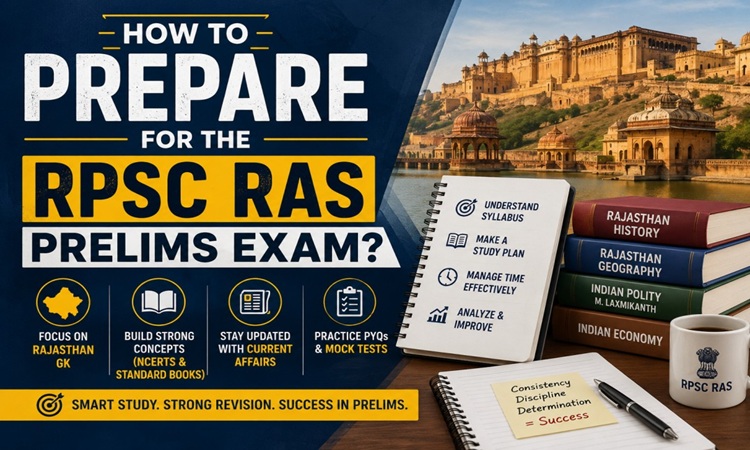
The RPSC RAS Prelims Exam is the first stage of the Rajasthan Administrative Services selection process conducted by the Rajasthan Public Service Commission (RPSC). Although the Prelims marks are not included in the final merit list, clearing this stage is essential to qualify for the RAS Mains Examination. Success in the RAS Prelims depends on conceptual clarity, consistent revision, regular mock tests, and effective time management. A structured preparation strategy can help aspirants cover the vast syllabus and improve their accuracy in the objective-type examination.
What is RPSC RAS Prelims Exam?
The RPSC RAS Prelims Examination is the first stage of the Rajasthan State and Subordinate Services Combined Competitive Examination conducted by the Rajasthan Public Service Commission (RPSC). It is an objective-type screening test designed to shortlist candidates for the RAS Mains Examination. While qualifying the Prelims is mandatory to progress to the next stage, the marks obtained in this exam are not included in the final merit list.
Top 10 Tips to Prepare RPSC RAS Prelims Exam
To clear the RPSC RAS Prelims Exam focus on Rajasthan-specific topics, as they carry significant weight in the examination. Give priority to Rajasthan History, Geography, Art and Culture, Economy, the Rajasthan Economic Survey, Budget, government schemes, and current affairs. Build a strong conceptual foundation with NCERT books and standard reference books such as Indian Polity by M. Laxmikanth. Strengthen your preparation by solving previous years’ question papers and attempting regular mock tests to improve speed, accuracy, and time management. Since the RAS Prelims follows a one-third (1/3) negative marking system, avoid random guessing and focus on calculated attempts. Aspirants can further enhance their preparation by joining the Vajirao & Reddy Institute Prelims Test Series 2026, which provides full-length mock tests, performance analysis, and exam-oriented practice. Here is a focused, step-by-step approach to help you clear the RPSC RAS Prelims:-
1. Understand the RPSC RAS Prelims Exam Pattern
The RPSC RAS Preliminary Examination is the first stage of the selection process. It consists of a single objective-type paper on General Knowledge and General Science, featuring 150 multiple-choice questions (MCQs) carrying a total of 200 marks. RAS aspirants are given 3 hours to complete the exam, which is conducted in both Hindi and English medium. Before starting your preparation, understand the exam pattern thoroughly.
- One paper: General Knowledge and General Science
- Objective-type (Multiple Choice Questions)
- 150 Questions
- 200 Marks
- Duration: 3 Hours
- Negative marking applicable as per RPSC rules
- Qualifying stage for the Mains Examination
Understanding the RAS exam pattern helps you allocate your study time effectively and prioritize high-scoring topics.
2.Know the Complete RPSC RAS Prelims Syllabus
The RPSC RAS Prelims syllabus is covered through a single objective-type paper on General Knowledge and General Science. The examination consists of 150 multiple-choice questions (MCQs) carrying a total of 200 marks and is conducted over 3 hours. As per the exam pattern, one-third (1/3) mark is deducted for every incorrect answer, making accuracy an important factor in scoring well. A thorough understanding of the syllabus prevents unnecessary study and keeps your preparation focused. The RAS Prelims syllabus is divided into 10 core sections includes:-
- History of India and Rajasthan
- Geography of India, Rajasthan, and the World
- Indian Polity and Constitution
- Indian Economy
- Rajasthan Economy
- Science and Technology
- Environment and Ecology
- Art and Culture
- Current Affairs
- Logical Reasoning and Mental Ability
Prepare a checklist of all topics and monitor your progress regularly.
3.Start with NCERT and Standard Books
Begin your RAS Prelims preparation by building a strong conceptual foundation with NCERT books (Classes 9–12). Once your basics are clear, move on to standard reference books for in-depth coverage of key subjects. Alongside national topics, dedicate sufficient time to Rajasthan-specific subjects, including History, Geography, Economy, Art and Culture, and Current Affairs, as they form a significant portion of the RPSC RAS Prelims syllabus. NCERT books provide conceptual clarity and are highly recommended for beginners. Suggested RAS exam study resources include:
- NCERT Books (Class 6–12)
- Indian Polity by M. Laxmikanth
- Rajasthan GK books
- Indian Economy reference books
- Geography Atlas
- Standard History books
- Science and Environment resources
Avoid collecting too many books. Revise the same sources multiple times.
4.Learn from Delhi Expert UPSC & RAS Faculty
Students at Vajirao & Reddy Institute Jaipur receive guidance from experienced Delhi faculty through a well-planned roster-based teaching schedule. Regular classroom sessions by subject experts from Delhi ensure that aspirants preparing for UPSC and RAS gain access to high-quality teaching, current exam trends, answer-writing techniques, and personalized mentorship while studying in Jaipur.
5.Prepare Rajasthan General Knowledge Thoroughly
Mastering Rajasthan General Knowledge requires a targeted approach divided into five core pillars: History, Geography, Polity, Art & Culture, and Economy. Success depends on understanding specific physical boundaries, historical dates, and state emblems, alongside regular revisions and practice. Rajasthan-specific topics carry significant weight in the examination. RAS aspirants focus on:
- Rajasthan History
- Rajasthan Geography
- Rajasthan Art and Culture
- Economy of Rajasthan
- Government Schemes
- Administrative Structure
- Important Personalities
- Festivals and Folk Traditions
Maintain separate notes for Rajasthan GK to simplify revision.
6.Daily Current Affairs for RPSC RAS Exam
Read current affairs daily with a clear focus on the RPSC RAS syllabus. Prioritize Rajasthan-specific news, state government schemes, important policy decisions, the Rajasthan Budget, and the Rajasthan Economic Survey. Also cover major national and international events relevant to the syllabus, and prepare concise notes for regular revision to strengthen both your Prelims and Mains preparation. Current affairs play an important role in both the RAS Prelims and Mains examinations. Follow these strategic steps for a highly effective daily routine:-
- Reading a national newspaper daily
- Following Rajasthan current affairs
- Preparing monthly current affairs notes
- Revising important government schemes
- Tracking national and international events
Daily reading for 30–45 minutes is sufficient if maintained consistently.
7.Solve RPSC RAS Previous Years’ Question Papers
Solve RPSC RAS previous year question papers regularly to understand the exam pattern, important topics, and the level of difficulty. Practice each paper under timed exam conditions to improve your speed and accuracy. Download the official question papers from the RPSC website or use trusted educational resources such as Vajirao and Reddy RAS Previous Year Question Papers for consistent practice and performance analysis. Previous years RAS papers help you understand:
- Frequently asked topics
- Question trends
- Difficulty level
- Time management
- Important subject areas
Analyze your mistakes after every practice session.
8.Take Regular RPSC RAS Mock Tests
Take RPSC RAS mock tests in a structured manner to maximize your preparation. Start with topic-wise tests to strengthen individual subjects, then move on to sectional tests to assess your progress. As the exam approaches, practice full-length mock tests under real exam conditions to improve speed, accuracy, and time management. Regularly analyze your performance, identify weak areas, and revise accordingly to enhance your overall score in both the RAS Prelims and Mains. Mock tests improve both speed and accuracy. RPSC RAS mock tests benefits include:
- Better time management
- Improved confidence
- Reduced exam anxiety
- Strong revision
- Identification of weak areas
Attempt one mock every week during the early stages and increase the frequency closer to the examination.
9.Prepare Short Notes for Revision for the RPSC RAS Exam
Prepare concise and high-yield revision notes for the RPSC RAS Exam by organizing information under clear headings and using keywords instead of lengthy sentences. Focus on important Rajasthan-specific facts, current affairs, government schemes, constitutional provisions, and key concepts. Well-structured notes make revision faster, improve retention, and help you recall important information during both the RAS Prelims and Mains examinations. Revision becomes easier when you maintain concise notes. Here is a template and strategy for condensing the most frequently tested topics into bite-sized, sub-headings your notes should include:
- Important facts
- Constitutional Articles
- Committees
- Government Schemes
- Maps
- Important Dates
- Economic Indicators
Quick revision notes save valuable time before the examination.
10.Improve Accuracy Instead of Guesswork in RPSC RAS Prelims Exam
Improve your accuracy in the RPSC RAS Prelims Exam by avoiding random guessing and adopting a strategic approach to answering questions. Read each question carefully, eliminate incorrect options, and attempt only those questions where you have reasonable confidence. Since the Prelims carries a one-third (1/3) negative marking for every incorrect answer, higher accuracy can significantly improve your overall score and increase your chances of qualifying for the RAS Mains Examination. Negative marking makes accuracy more important than attempting every question. To improve accuracy in the RPSC RAS Prelims Exam include:-
- Read every question carefully.
- Eliminate incorrect options.
- Avoid random guessing.
- Practice daily MCQs.
- Learn from every mistake.
Consistent practice naturally improves both speed and precision.
11.Follow a Realistic RPSC RAS Study Plan
A well-planned RPSC RAS study plan should balance static subjects, Rajasthan-specific topics, current affairs, and regular revision. Divide your preparation into two phases: the foundation phase, where you build conceptual clarity using NCERTs and standard books, and the intensive revision phase, where you focus on mock tests, previous years’ question papers, and answer writing practice. Aim to study 7-8 hours daily, allocating dedicated time slots for static subjects, Rajasthan GK, current affairs, MCQ practice, and revision to ensure complete syllabus coverage. A disciplined study routine ensures complete syllabus coverage without burnout. A sample RPSC RAS Study Plan daily:
- 2 Hours- Static Subjects
- 1 Hour- Rajasthan GK
- 45 Minutes- Current Affairs
- 45 Minutes- MCQ Practice
- 30 Minutes- Revision
Adjust the schedule according to your college or work commitments while maintaining consistency.
12.Revise Multiple Times
Revision is one of the most important aspects of RPSC RAS preparation, as the syllabus is vast and information-intensive. Limit your study resources to one standard book per subject and revise them multiple times instead of collecting too many materials. Follow a four-stage revision strategy—daily, weekly, monthly, and a final revision during the last 30 days before the exam. Complement your revision with active recall, short notes, MCQ practice, and previous years’ question papers to improve retention and boost your performance in the RAS Prelims and Mains. Revision is the key to retaining information. An effective revision cycle includes:
- Daily revision
- Weekly revision
- Monthly revision
- Full revision before the exam
Repeated revision strengthens memory and improves recall during the examination.
Common Mistakes to Avoid in the RPSC RAS Preparation
Many RPSC RAS aspirants make avoidable mistakes that negatively impact their preparation. One of the most common errors is underestimating the vast syllabus and giving insufficient attention to Rajasthan-specific topics, which carry significant weight in the Prelims examination. Candidates also tend to rely on too many study materials instead of mastering a few standard books, skip solving Previous Year Question Papers (PYQs), and fail to revise regularly. Staying focused on the official syllabus, using limited and reliable resources, practicing PYQs, and following a consistent revision schedule can greatly improve your chances of success. Many aspirants lose marks because of avoidable mistakes. Here Common Mistakes to Avoid in the RPSC RAS Preparation:-
- Ignoring the syllabus
- Skipping current affairs
- Reading too many books
- Not solving mock tests
- Poor time management
- Lack of revision
- Random guessing
- Studying without a timetable
Correcting these mistakes can significantly improve your performance.
Final RAS Preparation Tips
To improve your chances of success in the RPSC RAS Exam, focus on high-weightage topics, especially Rajasthan History, Geography, Economy, Art and Culture, and Current Affairs. For the Mains Examination, give special attention to General Hindi and General English, as strong performance in these subjects can significantly boost your overall score. Regularly solve previous years’ question papers, attempt mock tests under exam conditions, and dedicate 30–40% of your study time to revision. Consistent practice, effective time management, and repeated revision will help improve both your speed and accuracy in the examination. Aspirants seeking expert guidance and a structured preparation strategy can also enroll in the Top RAS Coaching in Jaipur to benefit from experienced faculty, comprehensive study material, and regular test series. Here are a few preparation tips for the RPSC RAS Exam that every aspirant should follow:
- Finish the syllabus well before the examination.
- Focus on conceptual clarity instead of memorization.
- Practice MCQs regularly.
- Revise Rajasthan GK frequently.
- Stay consistent with current affairs.
- Analyze every mock test.
- Maintain a healthy study routine.
- Stay confident and avoid last-minute stress.
Conclusion
Preparing for the RPSC RAS Prelims Exam requires a combination of smart planning, disciplined study, and continuous revision. Start with the official syllabus, strengthen your fundamentals through NCERTs and standard books, and dedicate equal attention to Rajasthan General Knowledge and current affairs. Regular mock tests and previous years’ papers will help improve your speed, accuracy, and confidence. With a consistent study routine and focused preparation, you can successfully clear the RAS Prelims and move one step closer to your dream of joining the Rajasthan Administrative Services.
Frequently asked questions (FAQs)
Success in the RPSC RAS Prelims Exam requires a clear understanding of the syllabus, regular revision, daily current affairs preparation, NCERT and standard book coverage, consistent mock test practice, and effective time management. Solving previous years’ question papers also helps identify important topics and exam patterns.
At Vajirao & Reddy Institute Jaipur, students are guided by experienced faculty from the Delhi centres through a roster-based teaching model, along with dedicated Jaipur faculty. Delhi-based subject experts regularly conduct classroom sessions, mentorship programs, and strategy workshops, ensuring aspirants preparing for UPSC and RPSC RAS receive quality academic guidance and exam-oriented preparation.
Yes. Vajirao & Reddy Institute Jaipur follows the same structured academic approach adopted at its Delhi centres. Students receive a well-planned curriculum, updated study material, regular test series, answer-writing practice, and exam-oriented classroom teaching designed by experienced faculty. Through a roster-based teaching model, Delhi faculty also conduct sessions at the Jaipur branch, ensuring aspirants benefit from the same quality of guidance, conceptual clarity, and strategic preparation that students receive in Delhi. This enables RPSC RAS and UPSC aspirants to experience a similar learning environment without relocating to Delhi.
Yes. The institute offers comprehensive coaching for both UPSC Civil Services Examination and RPSC RAS Examination. Students receive conceptual teaching, current affairs support, mock tests, interview guidance, and personalized mentorship to prepare effectively for their chosen examination.
Vajirao & Reddy Institute Jaipur combines a structured learning approach, experienced faculty, comprehensive study material, regular test series, and personalized mentorship. With academic support from Delhi-based faculty through roster-based classes, aspirants receive high-quality guidance while preparing for the RPSC RAS and UPSC examinations in Jaipur.
