
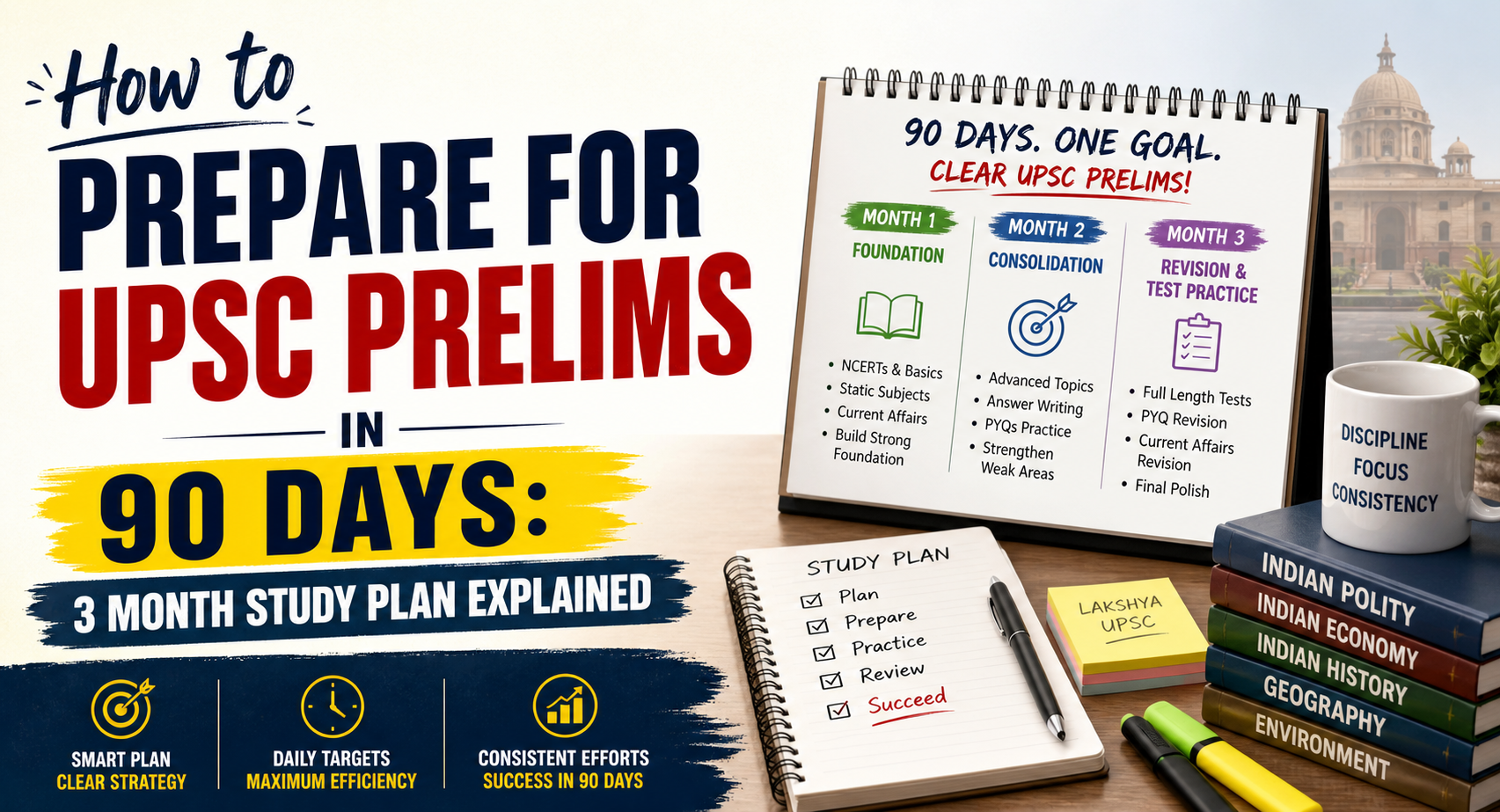
Prepare for UPSC Prelims in 90 days with a focused 3 Month strategy covering core subject revision, Smart planning & Regular mock tests for success. UPSC preparation for beginners needs a structured strategy to understand the UPSC syllabus and exam pattern, start with NCERTs, and build consistency. Focus on current affairs, choose the right optional subjects, follow disciplined study, revise regularly, and practice mock tests for accuracy and speed. Starting your UPSC preparation can feel overwhelming, but a well-structured 90 Day Study Plan for UPSC strategy can simplify the journey. The initial phase should focus on building strong fundamentals, developing consistency, and understanding the exam’s demands. By prioritizing NCERTs, current affairs, and core GS subjects, beginners can create a solid base for long-term success.
What is a UPSC Preparation Strategy for Beginners?
A UPSC preparation strategy for beginners typically spans 1-2 years, focusing on syllabus clarity, PYQ analysis, and building a strong base with NCERTs. Key steps include 6–8 hours of daily study, regular newspaper reading, choosing the right optional, and consistent answer writing practice. A UPSC preparation strategy is a structured roadmap that helps aspirants decide what to study, how to study, and when to revise. For beginners, the first three months are crucial for developing conceptual clarity and discipline. This phase emphasizes understanding the syllabus, selecting the right resources, and building effective study habits. Without a clear strategy, the vast UPSC syllabus can quickly become overwhelming.
What is the 90 Days Study Plan for UPSC Prelims Exam Preparation?
Key Focus Areas for Beginners:
A UPSC beginners UPSC strategy emphasizes mastering the UPSC syllabus, building strong fundamentals through NCERTs books, and maintaining a consistent, disciplined study routine for effective and sustainable preparation. Here the key focus areas for beginners:-
- Understanding the UPSC syllabus and exam pattern
- Choosing limited and reliable resources
- Building a consistent daily routine
- Starting current affairs preparation
Why the First 3 Months Matter in UPSC Preparation?
The first three months of UPSC preparation are crucial for building strong fundamentals through NCERTs books and standard books, establishing discipline and shaping the right strategy. This phase develops habits like answer writing, newspaper reading, and conceptual clarity, easing future preparation pressure. The first three months lay the foundation for your entire UPSC journey. A strong start improves retention, reduces stress and enhances overall efficiency. How to Crack UPSC Exam after 12th requires starting early with NCERTs, understanding the syllabus, developing current affairs reading habits, practicing answer writing and maintaining a disciplined, consistent study routine.
Why This Phase is Important?
The first three months of UPSC preparation are crucial for building a strong foundation, developing conceptual clarity, and forming consistent study habits. This phase streamlines resources, prevents burnout, and enables early, effective revision of NCERTs and core subjects.
- Builds strong conceptual clarity
- Develops discipline and consistency
- Prevents burnout in later stages
- Makes revision faster and more effective
Key Components of a 3 Month UPSC Strategy
A 3 month UPSC strategy focuses on intensive revision of core subjects, regular mock tests (30-40 full-length), and limited daily current affairs. Prioritize revising known sources over new ones, with a dedicated 45-60 minutes daily for CSAT practice. UPSC aspirants should ideally cover at least 12-15 months of current affairs, focusing on daily updates, monthly compilations, and revision cycles to ensure strong Prelims and Mains preparation consistency. A balanced strategy should integrate static subjects with current affairs while ensuring regular revision and answer writing. Instead of overloading yourself, focus on mastering the basics before moving to advanced topics.
Core Components include:
A successful 3 month UPSC strategy requires focused study (10-12 hours daily), targeting high-yield topics, rapid revision, and regular testing. Emphasize NCERTs, standard books, daily current affairs, PYQs, weekly revision and frequent mock tests.
- NCERT textbooks (Class 6-12)
- Standard books for Polity, History, and Geography
- Daily newspaper reading
- Weekly revision plan
- Basic answer writing practice
Month Wise UPSC Preparation Plan (First 3 Months)
The first 3 months of UPSC preparation focus on building a strong foundation with NCERTs, starting core subjects, and establishing a 6-8 hour daily routine with newspaper reading. Month 1 covers NCERTs, Month 2 adds standard books and optional subjects, and Month 3 emphasizes revision, PYQs and answer writing. A structured monthly plan helps track progress and maintain consistency.
Month 1: Build Your Foundation
Month 1 focuses on building a sustainable foundation by developing core habits rather than chasing quick results. This phase emphasizes discipline, consistency, and a structured “Build Your Foundation” approach for overall growth. Focus on NCERTs and basic concepts rather than memorization.
- Read NCERTs (History, Geography, Polity)
- Start daily newspaper reading
- Study 6–8 hours daily
- Make concise notes
Month 2: Strengthen Core Subjects
Month 2 of the UPSC 3 month plan focuses on strengthening core subjects Polity paper, History paper, Geography optional paper and Economy using standard books. Emphasize 2-3 hours of daily current affairs, start answer writing, and practice mock tests to build conceptual clarity. Move to standard reference books and deepen your understanding.
- Start Polity (Laxmikanth)
- Cover Modern History
- Continue current affairs
- Begin answer writing (2-3 questions daily)
Month 3: Integration and Practice
Month 3 emphasizes integration, intensive revision, and rigorous test practice to strengthen the foundation built earlier. Focus on PYQs and full-length mocks to identify gaps, while linking core subjects like Polity, Economy, and Environment with current affairs. Combine static knowledge with current affairs and increase practice.
- Revise all subjects
- Solve previous year questions (PYQs)
- Practice answer writing regularly
- Take sectional mock tests
UPSC Daily Study Routine for Beginners (2026 Self-Study Timetable)
For 2026 UPSC beginners, a consistent 8-10 hour daily routine is key. Allocate 3-4 hours to GS, 2-3 hours to the optional, 1-2 hours to current affairs include daily revision, with evenings for answer writing and consolidation. Beginners should follow a balanced UPSC daily timetable including current affairs, NCERT study, optional subject revision, answer writing practice, and regular CSAT practice with fixed revision and break schedules consistently. Here is a step-by-step daily study plan tailored for beginners preparing for the 2026/2027 exams.
- 2-3 hours: Static subjects (NCERTs/standard books)
- 1 hour: Current affairs
- 1 hour: Revision
- 30 minutes: Answer writing
- Weekly: Mock test or self-assessment
Common Top Mistakes First Time UPSC Aspirants Must Avoid
Mistakes to avoid in UPSC Preparation
Common UPSC preparation mistakes include ignoring the syllabus and NCERTs, poor revision, collecting excessive resources, skipping answer writing, and neglecting mental and physical health. Avoid these to improve consistency, clarity, and performance. Here Key Mistakes to Avoid:
- Using too many study resources
- Skipping revision
- Delaying answer writing practice
- Ignoring previous year questions
- Lack of consistency
Expert Tips to Maximise Your First 3 Months UPSC Preparation
To maximize your first 3 months of UPSC preparation, focus on mastering the syllabus, completing NCERTs, and maintaining a consistent newspaper routine. Follow a Mains-first approach, make short notes, revise weekly, begin answer writing early, and explore optional subjects. Smart preparation always outperforms hard but unstructured effort.
Best Practices:
Learn the best practices top UPSC aspirants follow proven strategies like consistent revision, focused study, answer writing, and smart resource selection to enhance efficiency and maximize success.
- Stick to limited and trusted resources
- Revise weekly without fail
- Make short, effective notes
- Start answer writing early
- Stay consistent with current affairs
Real Impact of a Strong 3 Month Strategy
A strong 3-month UPSC strategy, especially the final 90 days before Prelims serves as a crucial consolidation phase, converting scattered knowledge into exam-ready recall. While not ideal for absolute beginners, it can transform prepared candidates into successful aspirants. Many successful UPSC candidates credit their success to a strong foundation built in the first three months. A structured approach helps streamline preparation and improves performance in both Prelims and Mains.
Benefits include:
- Faster syllabus completion
- Better retention
- Improved answer writing skills
- Higher confidence in exams
How Vajirao and Reddy Institute Supports Beginners?
Vajirao and Reddy Institute supports beginners in UPSC preparation through a structured, guided approach with GS Foundation courses, personalized mentorship, and concise, updated study materials. The institute also offers doubt-solving sessions, regular mock tests, and flexible online/offline, weekend, and evening batches for comprehensive preparation. Under Vajirao and Reddy IAS Coaching Institutes in Delhi, beginners benefit from structured guidance, where Vajirao and Reddy Institute offers foundational learning, simplified concepts, regular practice, and mentorship to build UPSC preparation habits. Vajirao and Reddy Institute provides structured guidance for beginners through expert mentorship and well-designed programs. Their approach focuses on clarity, discipline, and result-oriented preparation.
Vajirao and Reddy Institute Key Support Features for Beginners:
For beginners, Vajirao and Reddy Institute offers a supportive environment with experienced faculty who simplify the complex UPSC syllabus and exam process, making preparation more structured and approachable.
- Foundation Building
- One-to-One Mentorship
- Comprehensive Study Material
- Regular Assessments
- Flexible Learning Options
- Doubt-Clearing Sessions
Choose the Best IAS Coaching Institute for UPSC Preparation
Conclusion: Start Strong, Stay Consistent
The first three months of UPSC preparation shape your entire journey. A disciplined and well-planned approach ensures clarity, consistency, and confidence. Focus on fundamentals, regular revision, and continuous practice to build a strong base. With the right strategy and guidance, you can stay ahead from the very beginning.
Frequently Asked Questions (FAQs)
How many hours should I Study in a day for UPSC CSE?
For a UPSC beginner, start with 4-6 hours of focused study in the first 3-4 months, emphasizing NCERTs and fundamentals. Gradually increase to 6-8 hours, and then 8-10 hours during the revision phase closer to the exam. A beginner should aim for 6-8 focused hours daily. Consistency and quality matter more than long, unproductive hours.
Which Books for UPSC IAS Prelims and Mains?
Begin UPSC preparation by building a strong foundation with NCERTs (Class 6–12) for History, Geography, Polity, and Economy. Complement these with standard books like Indian Constitution at Work, M. Laxmikanth’s Indian Polity, and Nitin Singhania’s Indian Economy.
Is 3 Months enough to Start UPSC Preparation?
Yes, three months are sufficient to build a strong foundation if you focus on basics, current affairs, and revision. Three months is usually insufficient for complete UPSC preparation, which typically takes 12-18 months. However, with a strong foundation, an intensive 10–12 hour daily plan, focused revision, high-yield topics, and rigorous mock practice, clearing Prelims is achievable.
When and How to Start Answer Writing Practice?
Start within the first 1-2 months. Begin with simple questions and gradually improve structure and clarity. Begin answer writing within the first 1-2 months of your UPSC preparation, once you have basic clarity from NCERTs and core subjects. Don’t wait to “finish the syllabus.”
Which IAS Coaching Institute Should I join?
You can prepare for the IAS exam (UPSC CSE) through coaching institutes, especially in hubs like Delhi and via online platforms. These institutes provide structured guidance, study materials, and mentorship. Leading options include Vajirao and Reddy Institute, SriRam IAS offering UPSC foundation, UPSC Prelims cum-Mains and UPSC optional subject courses to support preparation.
